Shipping Container Dolly
A shipping container dolly is the low-cost way to move a landed ISO container across a yard or warehouse floor without a crane. What we stock for the job is the HTS ECO-Skate ISOCON, a machine skate system that fits under the container's four bottom corner castings and rolls the whole box on non-marking polyurethane wheels. It ships as a matched set that covers all four corners, in safe working loads from 12 tonnes (26,400 lb) for an empty or lightly loaded box up to 64 tonnes (140,800 lb) for the heaviest loaded container with margin to spare. The skates slide a container, they do not lift it clear of the ground, so they pair with top-lift or bottom-lift gear whenever the box has to come off the floor.
Container Moving Carts Buying Guide
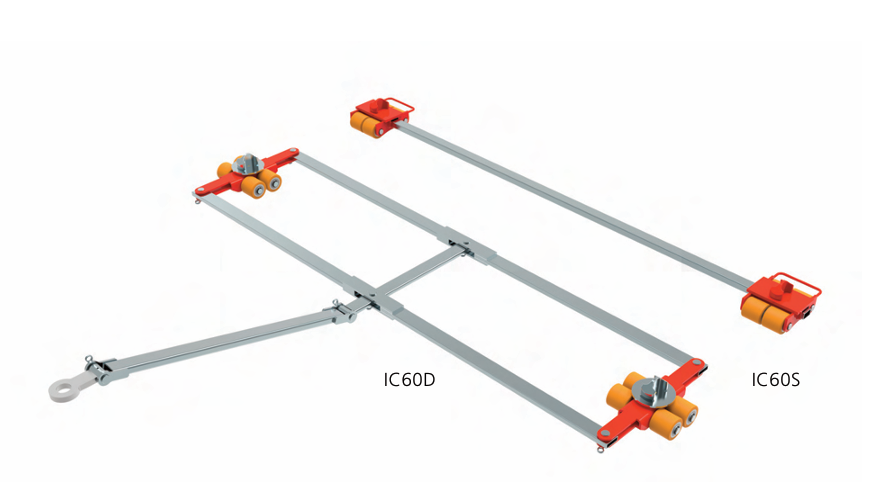
What comes in a set, and why it is four load points. The ISOCON is sold as a complete system, not a single skate. Each set pairs a driven lead unit with a trailing steered unit, written on our options as IC60D + IC60S for the 12 tonne set on up to ICX32D + ICX32S for the 64 tonne. The lead unit carries a tow handle for a forklift or tugger and the alignment bars that tie the two front corners together so they turn as one, while the trailing unit steers behind it. Between them they put a skate under each of the container's four bottom corners, so the load rides on four points and the rated tonnage is the safe working load of the whole set, not one wheel.
Size the set to the container, loaded or empty. A general purpose ISO container, 20 ft or 40 ft, has a maximum gross weight of 67,200 lb. That single number sets your floor. The 12 tonne (26,400 lb) and 24 tonne (52,800 lb) sets suit empty or partly loaded boxes, which is most in-yard repositioning. The first set that clears a fully loaded container with real margin is the 32 tonne ICX16 at 70,400 lb, and the 64 tonne ICX32 at 140,800 lb doubles that for overloaded or heavily built-out units. The price step reflects the jump: the standard IC series with its 3.3 in polyurethane rollers runs a few thousand dollars, and the larger XL ICX series with bigger rollers and a twist-lock securing head is the move up for full loads.
How the skate holds the box: cones and corner castings. Each skate has a flat top plate with an ISO container cone, replaced by a container twist lock system on the XL models, that drops into the oval aperture of the ISO 1161 bottom corner casting. That cone locates the box on the skate so it cannot creep or slide off under tow. Fitting them is a jacking job: raise each corner an inch or two with a toe jack, slide the skate underneath, then lower the corner so the casting settles onto the cone. Once all four are seated you connect the alignment bars and the tow handle, and the container is ready to roll.
The floor decides whether this works. Polyurethane wheels want a clean, smooth, level, hard floor, which in practice means finished concrete indoors or flat hard pavement. Debris, cracks, a slope, or soft ground will stop the job or make it unsafe, so clear and check the path before you jack anything. Steering angle on the lead unit is limited, so plan a wide arc rather than a tight pivot, and tow at a slow walking pace with a forklift or tugger. Moved this way, one or two people can walk a loaded box to a new spot for a fraction of what a crane pick costs, which is the whole reason skates exist.
What the skates do not do. A skate rolls a container, it never lifts one. The box has to already be on the ground, and the toe jacks do the small lift needed to fit the skates, nothing more. To take a container off a truck bed, off a stack, or onto a foundation, you still need the top-corner or bottom-corner lifting gear rated for the full box. Think of the ISOCON as the last, cheapest leg of the move: crane or forklift sets the container down, the skates carry it the rest of the way across the floor.
Frequently Asked Questions
Each set is a matched pair of units, a driven lead skate and a trailing steered skate, that together put a wheeled support under all four of the container's bottom corners. The lead unit includes a tow handle for a forklift or tugger and alignment bars that link the front corners, and every corner seats on a flat plate with an ISO container cone. Configurations run from IC60D + IC60S at 12 tonnes up to ICX32D + ICX32S at 64 tonnes.
A fully loaded ISO container can reach its 67,200 lb maximum gross weight, so the smallest set that covers a loaded box with margin is the 32 tonne ICX16 rated 70,400 lb. The 64 tonne ICX32 set at 140,800 lb gives more headroom for heavy or overloaded units. The 12 tonne and 24 tonne sets are sized for empty or lightly loaded containers, where most short in-yard moves happen.
A clean, smooth, level, hard surface. The non-marking polyurethane wheels roll well on finished concrete or flat hard pavement, but debris, cracks, slopes, or soft or uneven ground will bind the wheels or let the load shift. Clear and inspect the full path before you jack the container up.
Lift each corner an inch or two with a toe jack, slide a skate underneath, then lower the corner so the ISO corner casting settles onto the skate's cone. Work one corner at a time until all four are seated, then connect the alignment bars and tow handle. The skates only need enough clearance to slip under, not a full lift.
No. Container skates roll a box that is already on the ground; they do not lift it clear. The toe jacks provide the small lift required to fit the skates, and that is all. To raise a container off a truck, a stack, or a foundation you need top-lift or bottom-lift equipment rated for the full container weight.
Each skate has an ISO container cone, or a container twist lock system on the XL models, that drops into the corner casting aperture and locates the box on the skate. That positive engagement keeps the container from creeping or sliding off while it is under tow across the floor.