Stage Hoists
A stage hoist is a powered chain hoist built to fly lighting, audio, scenery, and truss above a stage or event floor, and this collection is the entertainment-rated end of our hoist catalog. It centers on the Harrington KREWMATE Hook Mini, a compact motor sized to tuck inside 12-inch truss, offered in single-phase (TEM) and three-phase (TSEM) versions. Both come in 500 and 1,000 lb capacities, ship in 10 ft or 60 ft lift heights, and take an optional chain container, with pricing that runs from around $2,300 to roughly $4,500 depending on how you spec it. These motors are engineered to entertainment standards, UL 1340, ANSI/ESTA, and German BGV-D8, which is what separates a stage hoist from the industrial chain hoist that would otherwise look identical.
Compare Entertainment Hoists
| Model | Price | Power | Capacity | Lift Height | |
|---|---|---|---|---|---|
| Harrington Black TNER Stage Electric Chain Hoist | $4,239 | 230V | — | — | View → |
| Harrington TEM Krewmate Hook Mini 1Ph Entertainment Hoists | $2,374 | — | 500-1,000 lb | 10-60 ft | View → |
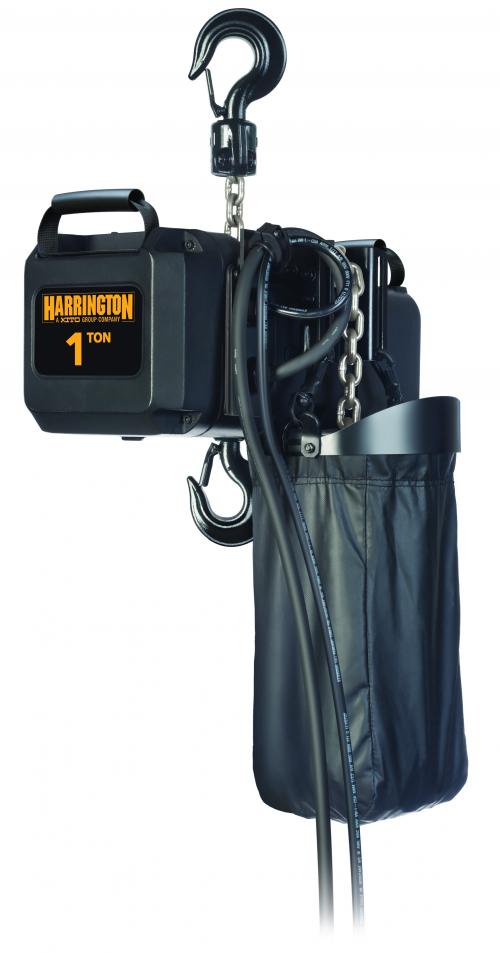 In Stock
 In StockIn Stock
Entertainment Hoists Buying Guide
Single-phase or three-phase: match the power on site. The one hardware choice that changes your part number is the incoming power. The TEM Krewmate is single-phase, the motor you reach for at a venue, a house of worship, or a mobile rig running off standard shop or generator power. The TSEM is three-phase, and its control system uses solid-state relay switching and a microcontroller for smoother starts and longer component life on daily-duty production work. Neither is better in the abstract; the right one is whatever your distro or building actually supplies. Confirm the voltage on the motor's data plate against your power before it ships, because a three-phase motor on single-phase power will not run, and correcting it later means buying a new hoist.
Size the capacity and lift height to the rig. Both versions come in 500 lb and 1,000 lb capacities and in 10 ft or 60 ft of lift. Rate the hoist to the point load it actually flies and leave margin, because a truss point rarely carries a single fixture, and a stage hoist becomes a life-safety device the moment anything hangs over an occupied floor. The 10 ft models cover a typical theater or ballroom trim height; the 60 ft models suit arenas, tall houses, and grids where the load starts near the deck and flies to a high point. Height of lift is set by chain length, so buy the reach you need rather than planning to add chain later.
What makes it a stage hoist and not an industrial one. A stage hoist earns the name through its standards and its build, not its capacity. The Krewmate is engineered to UL 1340, ANSI/ESTA, and German BGV-D8, the entertainment-industry requirements that ordinary industrial chain hoists are not held to. ESTA's ANSI E1.6 series governs powered hoist systems and the electric chain hoists used to lift and suspend loads for performance and production. Note that those standards cover suspending equipment, not flying people; lifting a performer needs purpose-built, people-rated equipment and a qualified engineer. Inside, the Krewmate runs a nickel-plated Grade 80 load chain, a non-drip grease-packed gearbox, a chain guide that keeps the chain from tangling, and a low-profile upper limit switch, the details that hold up under repeated show cycles.
Chain container, truss fit, and when to buy something else. Two spec choices are left. The optional chain container catches the loose chain as the hoist lifts so it does not pile on the deck or foul the load, and it adds roughly a hundred dollars, cheap for a cleaner, safer hang. The Mini's defining trait is its size: it is built to tuck inside 12-inch truss, which is why crews pick it to hide a point in a clean truss line. If your lift instead lives in a warehouse, a maintenance bay, or anywhere the hoist hangs over equipment rather than an audience, an entertainment motor is the wrong spend; a standard electric chain hoist does the same lift for less and is built for that duty.
Frequently Asked Questions
Buy the one that matches the power you can supply where the hoist works. The TEM is single-phase, the practical pick for venues, worship spaces, and touring rigs running off standard or generator power. The TSEM is three-phase, with a solid-state control system suited to daily production duty where three-phase power is available. Check the motor data plate against your distro or building supply before ordering, since a three-phase motor will not run on single-phase power.
No, not these. The Krewmate is rated for suspending equipment such as lighting, audio, scenery, and truss, and the ESTA E1.6 standards it is built to specifically cover hoisting loads, not flying performers. Any lift that carries a person over the deck requires purpose-built, people-rated equipment and sign-off from a qualified rigging engineer. Treat that as a hard line.
Rate the hoist to the actual point load, then add margin, because truss points usually carry more than one fixture and the load sits over people. Both the TEM and TSEM come in 500 lb and 1,000 lb. For lift height, the 10 ft models cover most theater and ballroom trim heights, while the 60 ft models are for arenas and tall grids. Height is fixed by chain length, so order the reach you need up front.
In almost every case, yes. The container catches the slack load chain as the hoist raises, keeping it off the deck and out of the load path, which matters most on the 60 ft models that pay out a lot of chain. It adds around a hundred dollars over the base motor, which is inexpensive insurance against a fouled hang or a pile of chain on stage.
Inspect before each use and on a documented periodic schedule, following ESTA's ANSI E1.6 series for electric chain hoists in the entertainment industry along with Harrington's own manual. Look for chain wear and stretch, hook deformation, limit-switch function, and legible markings, and keep the records. Duty on a hoist that flies loads over people is not a place to stretch inspection intervals.