Pallet Leveler
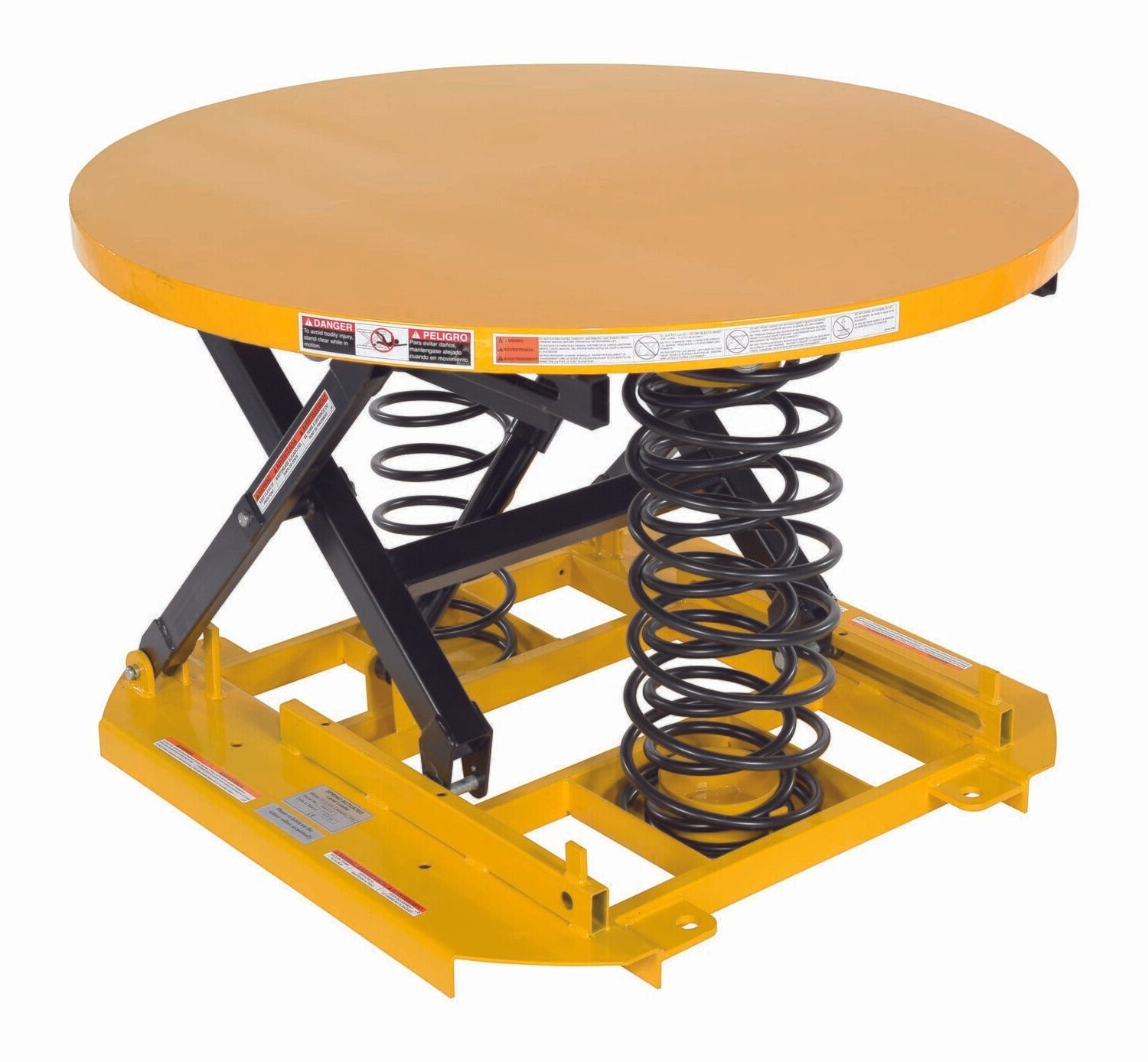
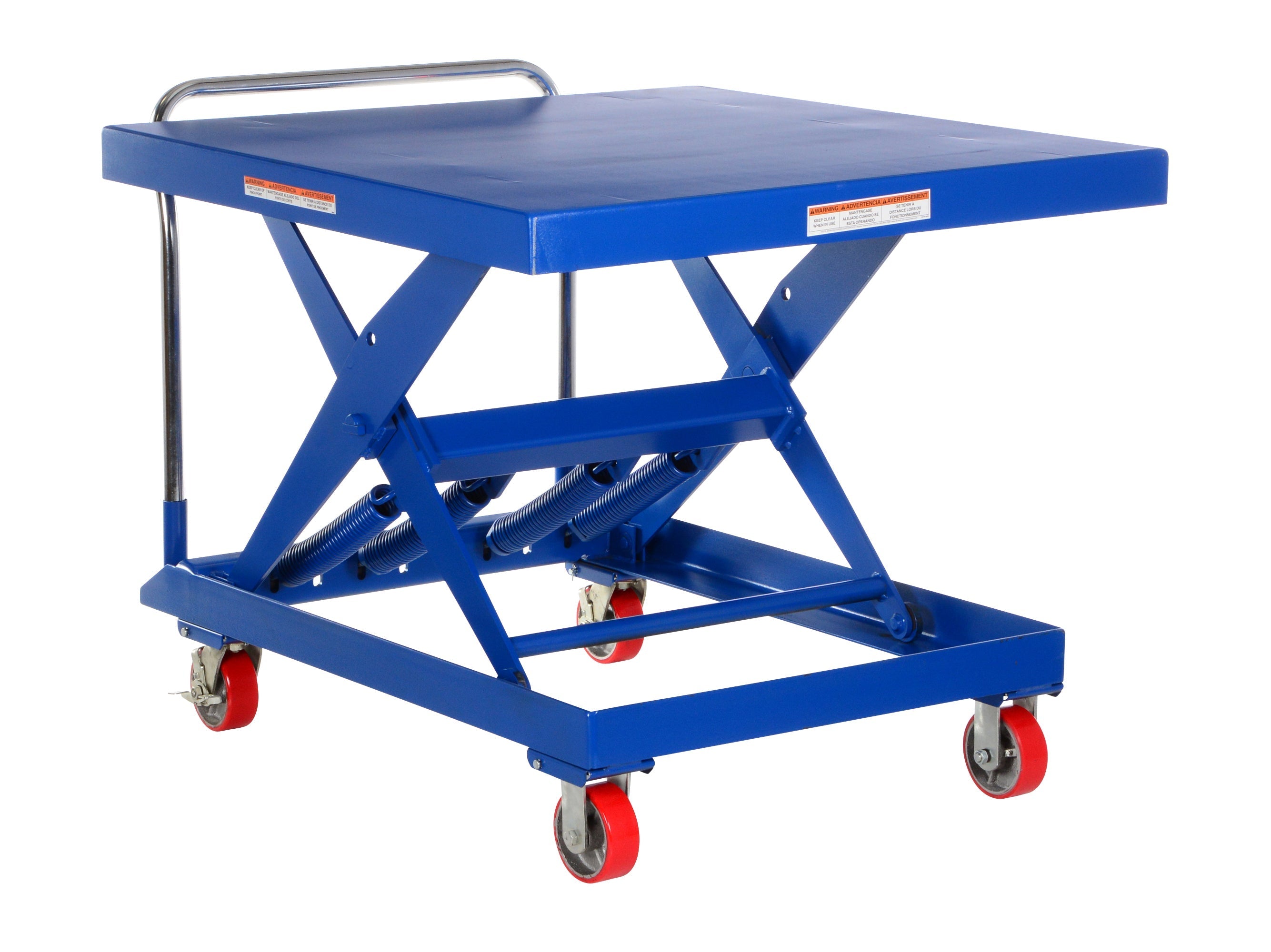
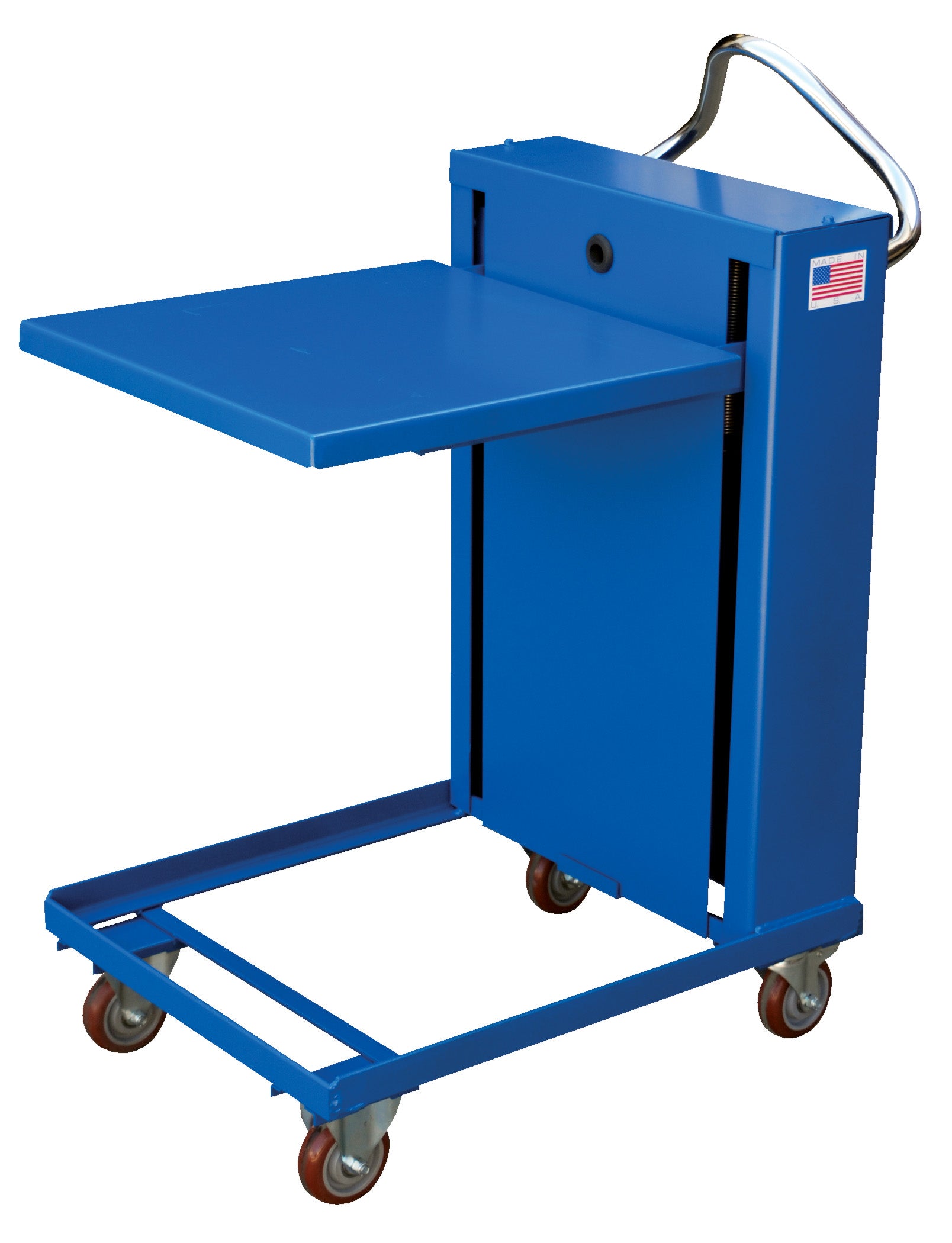
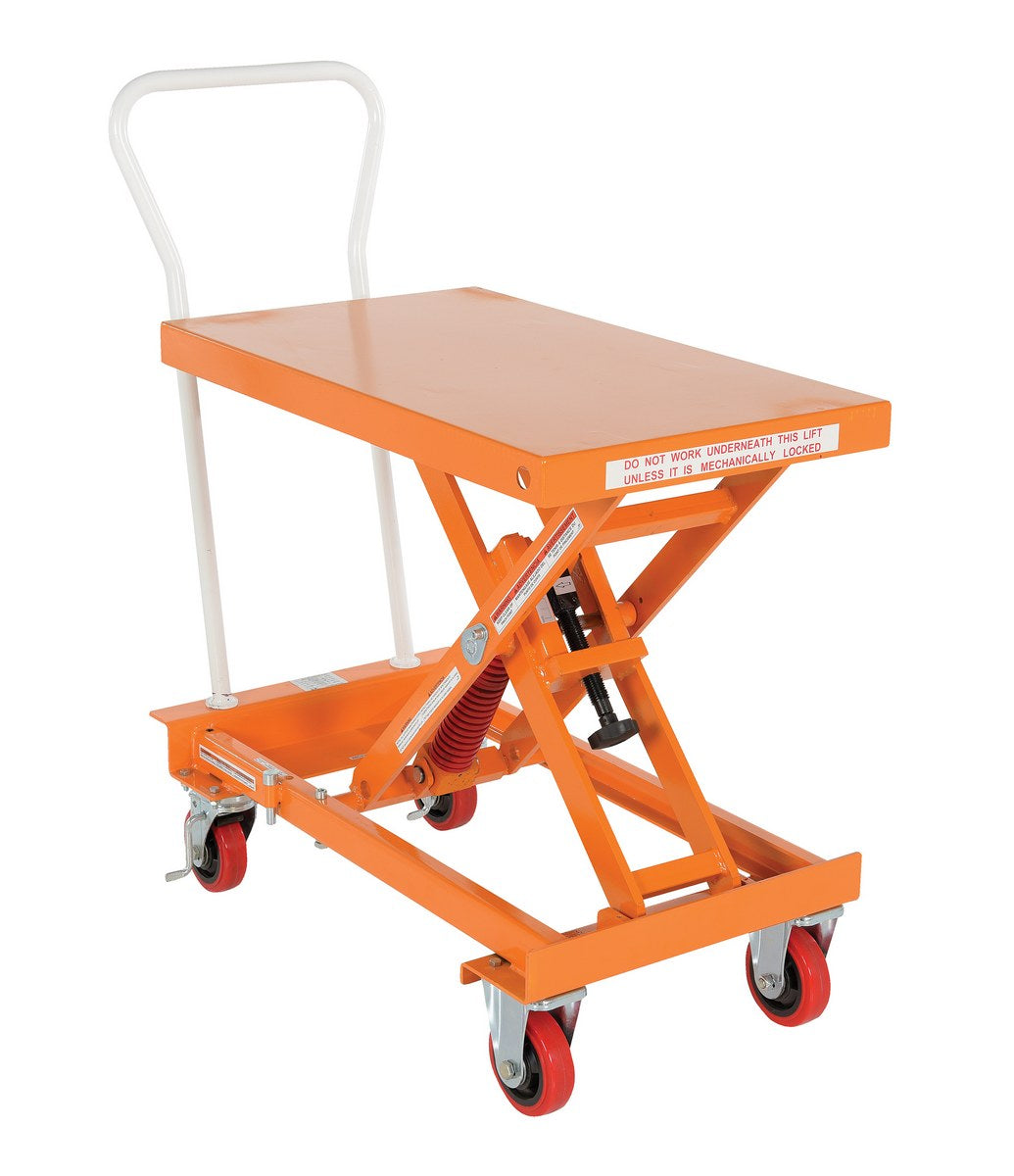
A pallet leveler is a spring-loaded platform that keeps the top of a pallet at a comfortable working height while a worker builds it up or breaks it down, with no power, no pedal, and no forklift shuttling the load up and down. The mechanism is simple and durable: calibrated springs under a scissor frame compress a little with every carton added and rebound as cartons come off, so the working layer stays in the same waist-to-chest band through the whole pallet. We carry the Vestil spring-actuated range end to end, from compact self-elevating tables around $870, through wider ETS spring tables, to the SST turntable positioner with a 360 degree rotating top, plus Auto-Hite spring carts that put the same self-leveling deck on casters. Every unit runs on springs alone, so there is nothing to plug in, nothing to lock out, and no hydraulics or motor to fail. This page covers how the spring set is matched to your load, why the rotating top earns its price, and where a powered table is the better buy.
Compare Self-Elevating Tables
| Model | Price | Capacity | |
|---|---|---|---|
| Vestil Automatic Spring-Actuated Pallet Elevating Scissor Lifter | $1,565 | — | View → |
| Vestil Auto-Hite Carts | $1,561 | 500-2,000 lb | View → |
| Vestil Self-Elevating Spring Tables | $1,363 | 230-1,120 lb | View → |
| Vestil Self-Elevating Lift Table | $871 | 400-800 lb | View → |
 In Stock
 In Stock
 In Stock
 In Stock
Self-Elevating Tables Buying Guide
How a spring pallet leveler actually works. There is no pump and no motor. A stack of coil springs sits under a scissor frame, and the springs carry the load. Set an empty pallet on the deck and it rides near the top of the travel; add the first tier of cartons and the springs compress just enough to drop the deck by roughly one carton's height, so the tier you just placed sits where the next one wants to go. Keep loading and the deck keeps settling, tier by tier, until a full pallet sits low in the frame with its top layer still at hand height. Break the pallet down and the process runs in reverse, the deck rising as weight comes off. The Vestil SST turntable model gives a service range from about 9 inches up to 27 and three quarter inches across that travel, which is the span between a full pallet and an empty one. Nothing about it is powered, which is the whole appeal: no electrical drop, no air line, no lockout before maintenance, and no cycle-life motor to wear out.
Match the spring rating to the real loaded weight. A spring positioner only levels cleanly inside the load band its springs are built for. Too light and the deck rides high and barely settles under a full stack; too heavy and it bottoms out early, which puts you right back to bending over a floor-level pallet. So size to the honest loaded weight, carton weight times tiers, not the average box. Our lineup is rated in discrete bands rather than one universal spring, which makes the pick concrete: the Vestil Self-Elevating Lift Table covers 400 and 800 lb from about $870, the ETS spring tables span 230, 460, 840, and 1,120 lb in 20, 24, and 30 inch platform widths up to roughly $1,580, and the Auto-Hite spring carts run 500 through 2,000 lb. Pick the model whose band brackets your fully loaded pallet, then confirm the empty-to-full weight swing falls inside it. If your loads vary wildly between light and heavy product, that swing is the number that decides whether a spring unit will track them or whether a powered table is the safer call.
The rotating top is the ergonomic multiplier. Loading a pallet from one fixed side means reaching across the deck for the far corners, and reaching across is exactly the twisting, extended lift that hurts backs. A turntable removes it. The Vestil SST positioner carries a 43 and five eighths inch diameter top that spins a full 360 degrees by hand, so the worker sets a carton on the near edge, gives the load a quarter turn, and the next corner comes to them. Every tier gets built from the same comfortable standing position. Choose the open top when you want the pallet itself to ride on the ring, or the steel top when you want a solid rotating deck under it, priced from about $1,565 to $1,899. Built-in fork pockets let a lift truck reposition the whole unit between stations. Pair the turntable with the spring leveling and you get both motions the body wants, height held constant and the far side brought within reach, without a single powered part.
Constant working height is the point, and NIOSH explains why. The reason a pallet leveler pays for itself is the lift it eliminates. Under the Revised NIOSH Lifting Equation, the recommended weight limit starts from a 51 lb load constant under ideal conditions and drops steeply as the lift moves away from the body, twists, or starts below knuckle height, with NIOSH advising the lifting index stay at or below 1.0. A pallet built on the floor forces the worst-case version of every one of those factors on the bottom tiers: deep bends, low origins, and long horizontal reaches. Keep the working layer in the knuckle-to-shoulder band and those multipliers move back toward favorable, which is precisely what the spring deck does automatically as the stack grows. OSHA has no numeric lifting limit of its own and points employers to the NIOSH equation as voluntary guidance, addressing manual handling hazards under the General Duty Clause. A spring positioner is one of the cleaner ways to answer that expectation, because it corrects the ergonomics passively without asking the operator to press anything.
Fixed table, turntable, or cart. The three shapes in this collection map to three workflows. A rectangular spring table, the ETS series or the smaller Self-Elevating Lift Table, suits a fixed pack or repack station where the pallet stays put and gets loaded from one or two sides. The SST turntable is the answer when the job is a four-sided pallet build and walking around the load is wasted time, or when the same station handles mixed cartons that need orienting. The Auto-Hite spring carts are the pick when the loaded pallet also has to travel, since they put the self-leveling deck on casters so one person can level and move between stations without a second machine. All three are spring-only, so the decision is purely about footprint, rotation, and mobility, not drive type. If the station also runs powered lifts for heavier or precise work, the broader lift tables range sits alongside these for the tasks springs cannot cover.
When a powered table beats a spring one. Spring leveling is passive, which is its strength and its limit. It holds a working height within a band, but it cannot deliver an exact height on demand, cannot lift a load outside its spring rating, and cannot lower flush to the floor for a pallet jack to roll a load on and off. If your process needs the deck parked at a set height for a machine feed, handles loads that swing far outside one spring band, or has to be ground-loaded by a pallet truck, a powered scissor or ground-lift table is the right tool, and those live in the powered lift tables catalog. The trade is honest: the powered unit gives you control and reach but adds an electrical or air supply, a motor, and the lockout discipline that comes with powered equipment. The spring positioner gives up that control and gives you a machine with nothing to plug in and effectively nothing to break. Match the tool to whether the job needs precise, on-command height or just needs the bending to stop.
Frequently Asked Questions
It is a spring-loaded platform that holds the top of a pallet at a steady working height as it is loaded or unloaded. Coil springs under a scissor frame carry the load: each tier of cartons compresses the springs a little, dropping the deck by about a carton's height, so the layer you are working stays at hand level. Remove weight and the deck rises again. There is no motor, pump, or air line involved.
No. Every unit in this collection is spring-actuated, so it runs on the springs alone. That means no electrical connection, no compressed air, no hydraulics, and no lockout procedure before maintenance. The trade is that a spring unit holds a height band automatically but cannot be commanded to an exact height the way a powered lift table can.
Size to the fully loaded weight of the pallet, not the average carton, because a spring positioner only levels cleanly inside the band its springs are rated for. Too light and the deck barely settles; too heavy and it bottoms out. Our models are rated in bands from 230 lb on the small ETS tables up to 2,000 lb on the Auto-Hite carts, so pick the one that brackets your real loaded weight and confirm the empty-to-full swing stays inside it.
The Vestil SST turntable carries a 43 and five eighths inch top that spins 360 degrees by hand, so a worker can build all four sides of a pallet from one standing position instead of walking around it or reaching across the load. Combined with the spring leveling, it removes both the deep reach and the low bend, which are the two motions the NIOSH lifting equation penalizes most.
Buy the spring positioner when the goal is to keep a pallet at working height during hand stacking, with no power drop and nothing to maintain. Choose a powered table when you need an exact height on demand, loads that fall outside a single spring band, or a deck that lowers flush for pallet-jack loading. The powered options sit in the broader lift tables range.
Not directly on these models, because the deck does not lower flush to the floor. The usual workflow is to set an empty pallet on the deck and build it in place, or to have a fork truck place a partial load; the SST turntable also has fork pockets so a lift truck can reposition the whole unit. If you need to roll a loaded pallet on and off at floor level, use a ground-lift or U-shaped powered table instead.