Soft Shackles
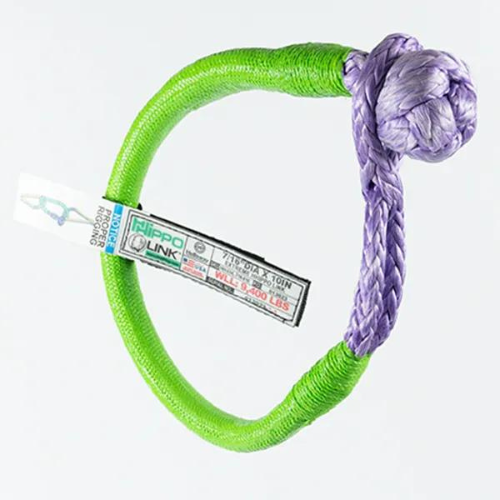
Soft shackles replace a steel bow shackle with a loop of high-strength synthetic rope, closed by a knot instead of a threaded pin. The one we stock is Holloway Houston's HHIppo Link, spliced from UHMWPE fiber in four sizes, from a 1/4 inch by 6 inch link rated 4,000 lb to a 7/16 inch by 10 inch link rated 9,400 lb, priced from about $48. Size for size a soft shackle weighs a fraction of steel, floats, will not mar a painted winch mount or a machined lug, and threads through tight eyes and lug holes a steel bow cannot enter. The trade is cut sensitivity. The guide below covers how the knot closes, where a soft shackle belongs, how to size it to the load, and when to reach for steel instead.
Soft Shackles Buying Guide
What it is and how it closes. A soft shackle is a length of rope with a diamond knot, sometimes called a button knot, worked into one end and an adjustable eye at the other. To close it you widen the eye, pass the rope around your two connection points, and seat the knot back into the eye; the eye tightens under load and the knot cannot pull through. There is no threaded pin to back out under vibration, nothing to cross-thread, and nothing to seize with rust after a season outdoors. The HHIppo Link uses this construction in UHMWPE fiber, the same class of rope used for synthetic winch line, which is where its strength-to-weight comes from.
Where a soft shackle earns its place. Two jobs bring people to this page. The first is vehicle recovery, where a soft shackle joins a strap or synthetic winch line to a recovery point. Because the whole shackle is low-mass rope, it stores far less energy than a steel shackle if a line parts, which is the main reason recovery crews carry them. Pair one with the snatch blocks for a change of pull direction, the winches that do the pulling, or the vehicle recovery jacks when a winch is not enough, all of which sit under Cargo Control and Tie-Downs. The second job is rigging: a sling-to-sling or sling-to-hardware connector that will not chew up a finished surface and threads through eyes a steel bow shackle is too bulky to enter.
Sizing to the load. The HHIppo Link comes in four sizes, and the working load limit climbs with rope diameter: 4,000 lb at 1/4 inch, 5,800 lb at 5/16 inch, 8,700 lb at 3/8 inch, and 9,400 lb at 7/16 inch. As with any rated component, that number sits below the break strength by a design factor that absorbs shock loading, wear, and the abuse hardware collects in the field, so rig to the working load limit and treat the reserve as protection rather than spare capacity. The discipline is the same one you would use for a steel bow shackle in rigging equipment: pick the size whose WLL clears the load with margin, and match it to the strap or sling it connects so the shackle is never the weak link.
The one real weakness: cut sensitivity. Synthetic rope has a weakness steel does not: it cuts. A soft shackle bearing on a sharp edge, a burr, or an abrasive casting can be sawn through at a fraction of its rating, and friction heat weakens the fiber. Keep it off sharp corners, inspect it before and after hard use, and retire it the moment you see cut strands, fuzzing, glazing, or a knot that has started to slip. For recovery points with cut edges, or connections that stay rigged and loaded for days, a steel bow shackle is still the right call. Most crews carry both and reach for the soft shackle first because it is lighter, faster to rig, and kinder to whatever it touches.
Frequently Asked Questions
The HHIppo Link is spliced from UHMWPE synthetic rope, the same high-strength fiber used in synthetic winch line. Size for size it is as strong as steel while weighing a fraction as much, and it floats.
Working load limit runs from 4,000 lb on the 1/4 inch by 6 inch size up to 9,400 lb on the 7/16 inch by 10 inch size, with 5,800 lb and 8,700 lb sizes in between. Rig to the working load limit, not the break strength.
Yes, and it is often the safer choice. Because it is made entirely of low-mass rope, it stores much less energy than a steel shackle if a line breaks. Keep a steel shackle in the kit for recovery points with sharp edges, since synthetic rope cuts.
Use steel when the shackle bears on a sharp edge or burr, or when a connection stays rigged and loaded for long periods. Soft shackles are best for clean connection points, sling-to-sling links, and finished surfaces you do not want to mar.
Widen the adjustable eye, pass the rope around both connection points, and seat the diamond knot back into the eye. Under load the eye tightens on the knot and holds, with no pin to thread or torque.
Take it out of service when you see cut or fuzzed strands, glazing or discoloration from heat, or a knot that slips. Unlike steel, a soft shackle shows its warning in the fiber, so inspect it before and after any hard pull.