Turnbuckles
Turnbuckles are the adjustable link that lets a rigger tension a line, take up slack, or square a load with a few turns of the body, and this collection covers the CM drop-forged range in two end configurations. The CM Turnbuckle Jaw/Eye starts at $41.50 and the CM Turnbuckle Jaw/Jaw at $48.08, both in hot-dip galvanized drop-forged steel on an open-body pattern with bolt-and-nut jaw ends. Thread diameters run 1/4 inch through 1-1/2 inch, take-up lengths from 4 to 24 inches, and working load limits from a few hundred pounds at the small end past 10,000 pounds at the 1 inch and larger sizes. The whole page turns on two picks: which end fittings you need, and sizing the thread to the load. The guide below walks through both, plus the derating and locking rules that keep an adjustable device from backing off under load.
Turnbuckles Buying Guide
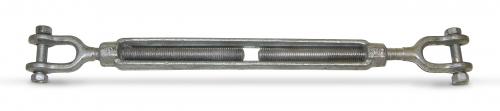
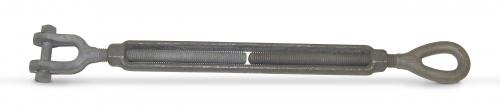
Jaw, eye, and the hook we leave off the page. A turnbuckle is an adjustable device with a body and two threaded end fittings, one cut right-hand and one left-hand, so a single turn of the body draws both ends in or lets them out at once. What changes from part to part is the ends. A jaw is a clevis closed by a bolt-and-nut pin that captures a shackle, eye, or link directly, and it is the most versatile termination because it connects to almost anything without extra hardware. An eye is a solid forged loop that needs a shackle or hook to attach but resists twisting and takes a cotter cleanly. The CM Turnbuckle Jaw/Jaw gives you two clevises for the fastest field connections; the CM Turnbuckle Jaw/Eye pairs one clevis with a fixed loop for the end that anchors permanently. You will notice there is no hook end here, and that is deliberate: hook-end turnbuckles can disengage and are not recommended for overhead lifting or critical tensioning. For the connectors that mate to these ends, see the bow shackles and screw-in lifting points this collection sits under.
Size the thread to the load, the take-up to the travel. Two numbers name every turnbuckle: thread diameter and take-up. Thread diameter sets the working load limit; take-up is only the adjustment range, the inches the body opens and closes. Working load limit climbs with diameter, and it is the same whether you buy jaw/jaw or jaw/eye: the 3/8 inch carries 1,200 lb, 1/2 inch 2,200 lb, 5/8 inch 3,500 lb, 3/4 inch 5,200 lb, 7/8 inch 7,200 lb, and the 1 inch reaches 10,000 lb, with the 1-1/4 and 1-1/2 inch sizes above that. Take-up runs 4 to 24 inches by size, so pick the diameter that clears your load with margin first, then the take-up that spans the slack you need to pull out. All of it is drop-forged carbon steel, hot-dip galvanized to shed corrosion outdoors.
In-line pulls only, and lock it before you load it. A turnbuckle is rated for a straight in-line pull along its axis. Angle-load it and you bend the end fittings against their design; overloading past the working load limit is never permitted. ASME B30.26 covers turnbuckles as adjustable rigging hardware, and its inspection routine is quick to run: confirm a legible WLL and identification, look for bent or stretched end fittings, cracked or nicked threads, and a body that turns freely without binding, and pull from service anything that fails. The habit that separates a safe install is locking the body. Adjusting threads can back off under vibration and cyclic load, so once the tension is set, secure it with a jam nut snugged against each end fitting or mouse the body to the fittings with safety wire so it cannot spin loose. Set it, lock it, then load it.
Frequently Asked Questions
The jaw end is a clevis closed by a bolt-and-nut pin, so it connects directly to a shackle, link, or eye with no extra hardware. The eye end is a solid forged loop that needs a shackle or hook to attach but resists twisting. Choose jaw/jaw when both ends get connected and disconnected in the field, and jaw/eye when one end anchors permanently to a fixed point. Both configurations carry the same working load limit at a given thread diameter.
Only when it is properly rated, installed in-line, and used within the manufacturer's working load limit. Turnbuckles are rated for a straight pull along their axis, never a side or angle load, and overloading is not permitted. Hook-end turnbuckles are not recommended for overhead lifting because the hook can disengage, which is why this collection stocks jaw and eye ends only.
The working load limit is set by thread diameter, not take-up length. In the CM range the 3/8 inch holds 1,200 lb, 1/2 inch 2,200 lb, 5/8 inch 3,500 lb, 3/4 inch 5,200 lb, 7/8 inch 7,200 lb, and the 1 inch reaches 10,000 lb, with the 1-1/4 and 1-1/2 inch sizes above that. Size the diameter to your load with margin, then choose the take-up that spans the slack you need to remove.
Once you have set the tension, lock the body so the threads cannot back off. Snug a jam nut against each end fitting, or mouse the body to the end fittings with safety wire. Both stop the body from spinning loose under vibration and cyclic load. Verify the lock is in place during every inspection.
ASME B30.26, the rigging hardware standard, covers turnbuckles as adjustable hardware. Before each use, confirm a legible working load limit and identification, check the end fittings for bending or stretch, inspect the threads for cracks or nicks, and confirm the body turns freely without binding. Remove any turnbuckle that fails these checks from service.