Diesel Forklifts
A diesel forklift trades the quiet of an electric truck for raw pulling power, which is why it earns its keep outdoors: lumberyards, precast yards, ports, and any job that lives on gravel, mud, and grade. We carry the EKKO EK-series diesel line, a sit-down counterbalance truck offered in rated capacities from 4,000 lb up to 8,500 lb, priced in the mid-thirty to mid-forty thousand range depending on the capacity. These are outdoor machines by design. A diesel engine and pneumatic tires give the torque and traction that hard-surface electric trucks cannot, and the trade for that is exhaust, which is what keeps them out of enclosed rooms. The guide below walks the fuel choice, the capacity math, and the rules to check first.
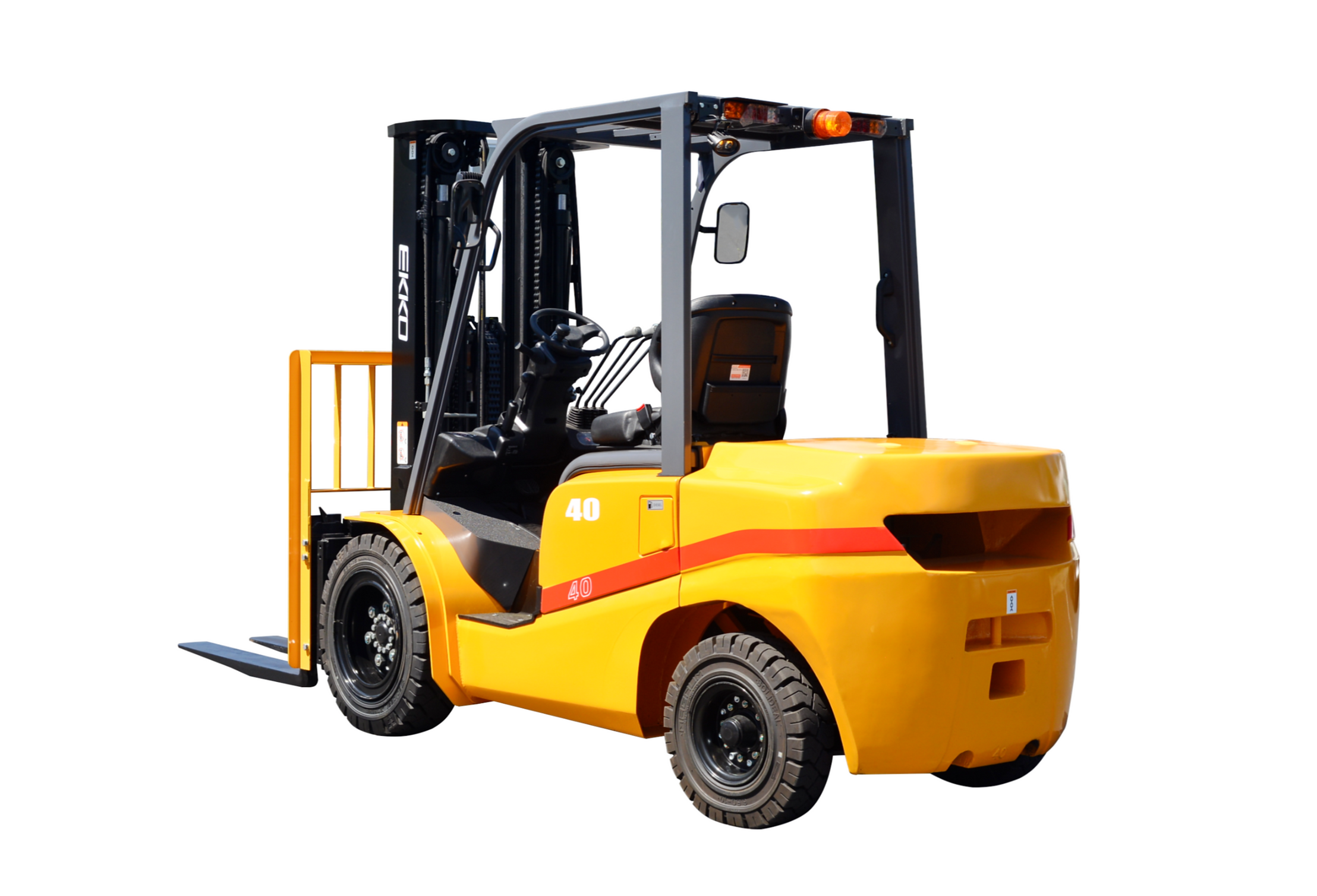
Diesel Forklifts Buying Guide
Diesel means outdoors, and that is the first decision. A diesel engine burns fuel on board, and that exhaust is the whole reason these trucks live outside. OSHA notes that internal combustion trucks can build high levels of carbon monoxide in enclosed work areas, and diesel adds particulates on top of the CO, so a warehouse or any poorly ventilated room is the wrong home for one. If the work is indoors, the fuel choice moves to LPG forklifts, which run cleaner and can work inside with adequate ventilation, or to sit-down electric forklifts, which emit nothing at the point of use and are the safest indoor pick. Buy diesel when the truck spends its day in open air and needs to keep pulling.
Size the capacity at the load center, then again at height. Every forklift states its rated capacity on a data plate, measured at a standard 24 inch load center, the distance from the fork face to the load's center of gravity. Push the weight farther out on the forks and the safe capacity drops, and lifting to full mast height can leave only about 60 to 70 percent of the ground-level rating. So size to the real load, at its real center, at the height you actually stack. The EKKO diesel line is rated from 4,000 lb on the EK20D up to 8,500 lb on the EK40D, in 1,000 to 1,500 lb steps, which covers palletized freight through heavy single pieces. Pick the rating above your worst case, not right at it.
Diesel earns its price on power and terrain. Power is where diesel separates from the alternatives. A diesel drive makes on the order of 50 percent more torque than a comparable electric truck, which is what carries a loaded lift up a grade or through soft ground without bogging down. Pneumatic tires back that up with grip and shock absorption on gravel, soil, and broken pavement that cushion tires cannot match. Refueling is a two-minute job rather than a charge cycle, so a diesel machine keeps working across back-to-back shifts. That sustained, heavy, outdoor duty is exactly the job these trucks are built for, and it is where paying for a diesel over an electric makes sense.
Training, the data plate, and the standards. Whatever the fuel, the operator has to be trained. OSHA 1910.178(l) requires the employer to train, evaluate, and certify every powered industrial truck operator, with the certification recording the operator's name, the training and evaluation dates, and who performed them; re-evaluation runs on a three year cycle. The design and operation rules sit in ANSI/ITSDF B56.1, the safety standard for low and high lift trucks. Keep the data plate legible and never exceed the rating it shows, inspect the truck at the start of every shift, and confirm the ground can carry a loaded machine before you drive out onto it.
Frequently Asked Questions
Generally no. Diesel exhaust puts both carbon monoxide and particulates into the air, and OSHA warns that internal combustion trucks build high CO levels in enclosed areas, so diesel is treated as an outdoor machine. For indoor work choose an electric truck, which emits nothing at the point of use, or an LPG truck run with adequate ventilation. Reserve diesel for open-air duty where the exhaust dilutes.
Read your load at a 24 inch load center, the reference point every data plate uses, then remember capacity falls as the load moves out on the forks and as you lift, leaving roughly 60 to 70 percent of the ground rating at full mast height. The EKKO diesel line runs from 4,000 lb up to 8,500 lb, so pick the rating that clears your heaviest real load with margin rather than the one that just barely covers it.
Torque and terrain. A diesel drive makes around 50 percent more torque than a comparable electric truck, and on pneumatic tires it grips gravel, mud, and rough grade that hard-tire machines struggle with. Refueling takes minutes, so it runs across shifts without a charge cycle. If the work is indoors or on smooth floors, an electric or LPG truck is the better and safer buy; diesel is for heavy outdoor duty.
Yes. OSHA 1910.178(l) requires the employer to train, evaluate, and certify every forklift operator before they run the truck, and to keep a record with the operator's name, the training and evaluation dates, and who conducted them. Operators are re-evaluated at least every three years, and sooner after an incident or a change in equipment or conditions.
The EKKO diesel line is priced by capacity, from about $33,600 for the 4,000 lb EK20D up to roughly $46,200 for the 8,500 lb EK40D. Request a quote for bulk pricing. Freight and lead time are confirmed at checkout, and business leasing is available if you would rather spread the cost.