Order Picker Forklifts
An order picker forklift raises the operator and the load together, so a picker steps onto a platform at rack height and pulls individual cases or parts straight off the shelf instead of bringing a whole pallet down to the floor. That is a different job from a counterbalance truck or a reach truck: the person goes up with the goods. Our range is built on EKKO's electric order pickers, split into a light 220 lb class for one-person case and small-parts picking high in the racks and a 1,500 lb class that carries a loaded platform or partial pallet. All run on 24V power, the heavier units ride on 37 inch forks, and reach heights climb into the mid-teens of feet depending on the model. Pricing sits in the high five figures, and freight, lead time, and business leasing are settled at checkout.
Compare Order Pickers
| Model | Price | Capacity | Overall Length | Fork Length | Lift Height | |
|---|---|---|---|---|---|---|
| EKKO EOP150-216LI 1500lbs Order Picker 216" Lift | $37,999 | 1,500 lb | 101" | s/e/l 1.6/5/42" | 165 | 216" | 275" | View → |
| EKKO EOP150-165LI 1500lbs Order Picker 165" Lift | $35,999 | 1,500 lb | 101" | s/e/l 1.6/5/42" | 165 | 216" | 275" | View → |
| EKKO EOPL150-165LI 1500lbs Order Picker 165" Lift | $33,999 | 1,500 lb | 98" | 1.2/4/35" | — | View → |
| EKKO EOP22-216LI 220lbs Order Picker 216" Lift | $31,999 | 220 lb | — | — | 165" Lift Height | View → |
| EKKO EOP22-165LI 220lbs Order Picker 216" Lift | $28,999 | 220 lb | — | — | 165" Lift Height | View → |
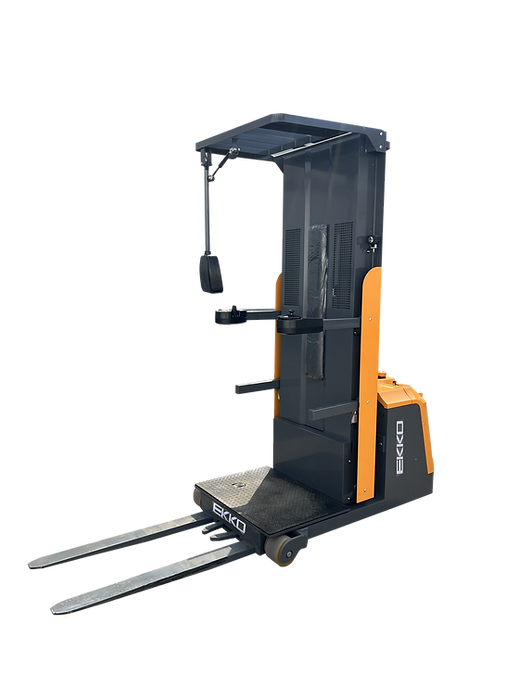 In Stock
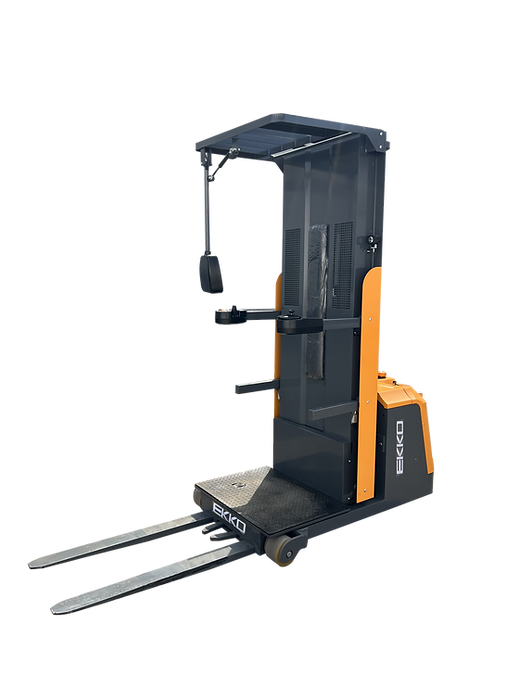 In Stock
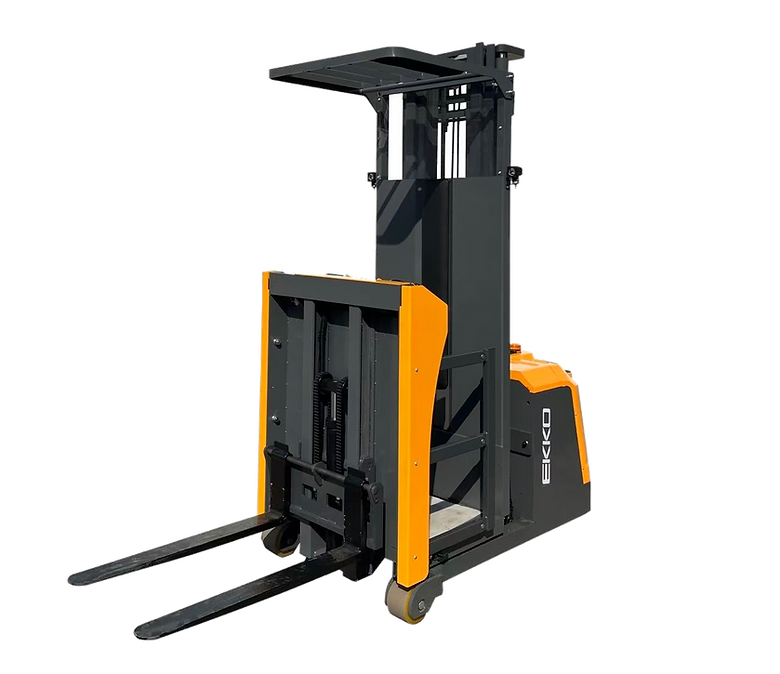 In StockIn Stock
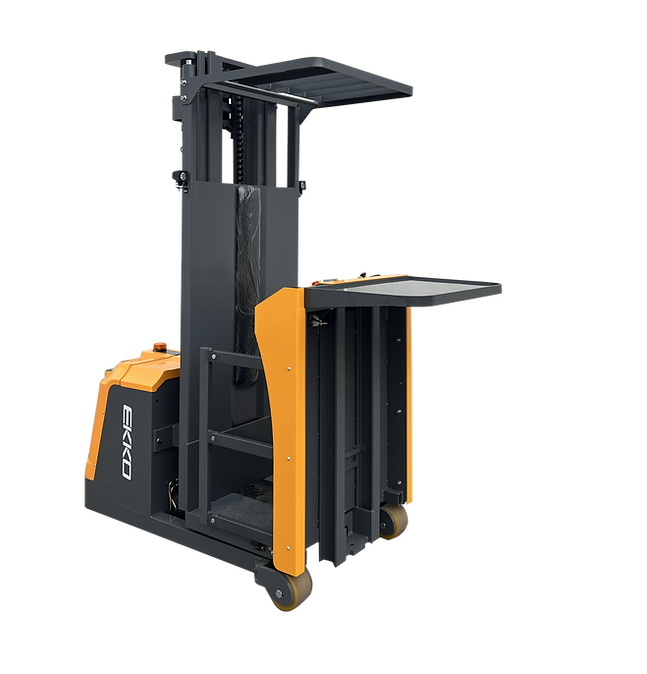 In StockIn Stock
Order Pickers Buying Guide
What an order picker does, and when it beats a forklift. An order picker brings the worker to the product. Instead of pulling a whole pallet down with a forklift truck and picking from it on the floor, the operator rides a platform up to the rack face and takes individual cases, cartons, or small parts straight off the shelf, then sets them on the deck beside their feet. That split decides whether you need one of these at all: if you ship full pallets, a counterbalance or reach truck is the right machine, but if you break pallets and pick eaches or cases from racking above head height all shift, an order picker removes the ladders, the reaching, and the trip up and down for every line. The operator and the load rise together, which is what separates this Class II truck from everything else on the parent page.
Match the capacity class to what you pick. Our EKKO pickers fall into two capacity classes, and they answer different pick profiles. The 220 lb EOP22 models are built for one person lifting cases and small parts high in the racks, where the weight on the platform is the operator plus a modest armful of goods and the priority is getting up to height quickly; they run $28,999 to $31,999 on our site. The 1,500 lb EOP150 and EOPL150 models carry a loaded picking platform or a partial pallet, so they suit heavier cases, mixed-SKU pallet building, and any pick where the deck fills up before the route is done, priced from $33,999 to $37,999. The heavier units ride on 37 inch forks and all of them run on 24V power. Total the real platform weight, operator, tools, and the heaviest state the load reaches mid-route, then buy the class that clears it with margin.
Reach height: buy the pick level you have, not the tallest mast. The second number in each EKKO model name is the lift height in inches, and our range runs from about 165 up toward 216, which puts the platform into the mid-teens of feet. Order pickers as a category reach anywhere from roughly 15 feet at the low end to 40 feet in the tallest very-narrow-aisle machines, so the number you need is set entirely by your top pick level. Measure the height of your highest occupied shelf, not the top of the steel, and buy to that. Paying for a taller mast you never use costs money up front and makes the truck heavier and slower to position. If every pick sits at floor and first-beam level, a man-up picker is more machine than the job needs, and a walk-behind stockpicker truck does the same low-level work for far less.
Fall protection is part of running a man-up truck. A man-up truck puts a person at height on a moving platform, so personal fall protection is part of operating one, not an accessory. ANSI/ITSDF B56.1, the standard these trucks are built to, requires a personal fall protection system sized to the operator's weight: a full-body harness with either an energy-absorbing lanyard or a self-retracting lanyard, anchored only to the truck's approved anchor point and never to the racking. OSHA's powered industrial truck rule does not spell out the harness itself, but OSHA cites employers under the general duty clause when a man-up operator works unprotected, so treat B56.1 as the floor. Harnesses, lanyards, and self-retracting devices live in fall protection, and you inspect them before every shift the same way you inspect a sling.
Operators must be trained and certified. Every order picker operator has to be trained, evaluated, and certified before running the truck. OSHA's 29 CFR 1910.178(l) requires certification by powered-industrial-truck type, and the order picker is its own type: time on a sit-down counterbalance does not carry over. In the classification system these are Class II electric motor narrow aisle trucks, lift code 2, the same family as reach and turret trucks. Certification is the buyer's responsibility to arrange, it has to be refreshed on the schedule the rule sets, and it has to be renewed any time an operator moves to a different truck type.
Aisle width, floor, and power all sit in the plan. Order pickers earn their keep in narrow aisles, which is where the pick-face density that justifies them lives. They are electric, indoor machines that want a smooth, level, dry floor: the tall mast amplifies every dip and the platform is unforgiving of a truck that rocks. Plan the aisle width around the truck plus load plus clearance, confirm your floor is rated and flat, and make sure the racking, any guide rails or wire guidance, and the charging area are all in the plan before the truck arrives. For putting pallets away and pulling full pallets in those same aisles, pair the picker with a stand-up reach truck rather than asking one machine to do both jobs.
Frequently Asked Questions
A standard forklift brings the load to the operator: the mast lifts a pallet and the driver stays at floor level. An order picker does the reverse, raising the operator and a load platform together so the picker takes individual cases or parts straight from the rack at height. Use a counterbalance or reach truck when you move whole pallets, and an order picker when you break pallets and pick eaches or cases from elevated racking.
Yes. These are man-up trucks, and ANSI/ITSDF B56.1 requires a personal fall protection system sized to the operator's weight: a full-body harness with an energy-absorbing or self-retracting lanyard, anchored to the truck's approved anchor point. OSHA can also cite an employer under the general duty clause for an unprotected man-up operator. We carry the harnesses and lanyards in the fall protection collection.
Yes. OSHA's 29 CFR 1910.178(l) requires every powered industrial truck operator to be trained, evaluated, and certified for the specific truck type. The order picker is its own type, so certification on a sit-down forklift does not transfer. It is refreshed on OSHA's schedule and renewed whenever an operator switches truck types.
Our EKKO range lifts to roughly 165 to 216 inches, the mid-teens of feet, set by the second number in each model name. Order pickers as a category run from about 15 feet up to 40 feet in the tallest very-narrow-aisle machines. Buy to the height of your highest occupied shelf rather than the top of the racking.
Our EKKO pickers come in a 220 lb class for one-person case and small-parts picking and a 1,500 lb class that carries a loaded platform or partial pallet. Total the operator, tools, and the heaviest weight the load reaches mid-route, then buy the class that clears it with margin.
Not really; they are complementary Class II narrow-aisle trucks. An order picker is built for picking cases and eaches with the operator up at the rack, while a reach truck is built to store and retrieve full pallets from the floor. In a narrow-aisle operation you usually run both.