Forklift Forks
Forklift forks are the blades that actually carry the load, and picking the right set starts with how they mount to your machine rather than how long they are. This collection is built entirely around Star Industries, and it spans two very different mounting families. Hook-type ITA forks hang on a standard forklift carriage, while shaft-mounted forks pin into the carriage of a telehandler or rough-terrain forklift. Alongside those you will find slide-on fork extensions for reaching deeper loads and over-the-bucket tine sets that turn a loader or tractor bucket into a working set of forks. The telehandler shaft forks make up most of the range, cut to fit machines from JLG, CAT, Skytrak, Lull, JCB, Genie, Terex, Skyjack, Gehl, and Ingersoll Rand. Pricing runs from around $150 for a single blade up to roughly $3,600 for a long heavy-duty pair, so the guide below sorts the decision by mount first, then by size.
 In StockIn Stock
 In Stock
 In StockIn StockIn Stock
 In StockIn StockIn StockIn StockIn StockIn StockIn StockIn StockIn StockIn StockIn StockIn StockIn Stock
Fork Extensions Buying Guide
Match the mount before anything else. Forks come in two mounting families that do not interchange, so this is the first fork in the road. Hook-type forks, the ITA standard, hang on a carriage using opposing hooks that engage an upper and lower fork bar, and a latch pins them in place. That is what most sit-down warehouse forklifts use. Shaft-mounted forks are a different animal: they slide onto round shafts on a pin-type carriage, which is how telehandlers and rough-terrain forklifts hold their forks. A hook fork will not fit a shaft carriage and vice versa. The Star Industries range covers both, but the shaft-mounted line is the deeper one, with sets cut for specific machine families. Before you shop by length or capacity, confirm which carriage your truck has, because it decides the entire shortlist.
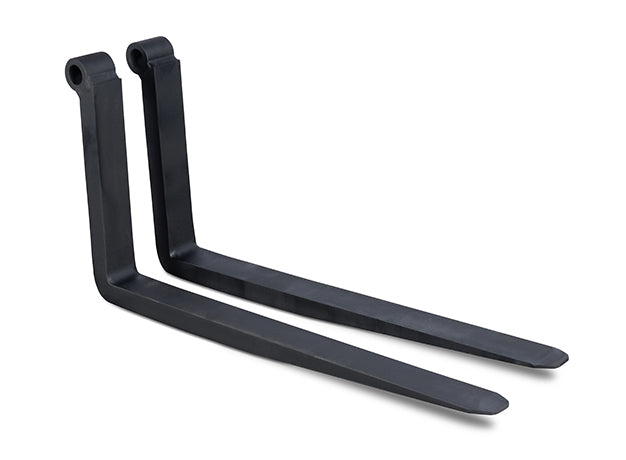
ITA hook-type forks: your carriage class picks the fit. ITA forks are grouped by class, and the class is simply the carriage height, the vertical distance between the two fork bars. Class 2 is a 16 inch carriage and generally covers trucks from about 1,500 to 5,500 lb. Class 3 is a 20 inch carriage for roughly 5,500 to 11,000 lb machines, and Class 4 is a 25 inch carriage for the heaviest lift trucks above that. Match the class to your carriage and the fork hooks drop straight on. This collection carries pallet forks in Class 2, 3, and 4, plus block forks in Class 2 and 3. The naming matters at checkout: pallet forks are sold as a pair, while block forks are priced each, so a two-fork job means ordering two block forks. Pallet forks are the general-purpose blade for pallets and crates; block forks are shorter, thicker units built for handling brick, block, and dense unit loads close to the carriage.
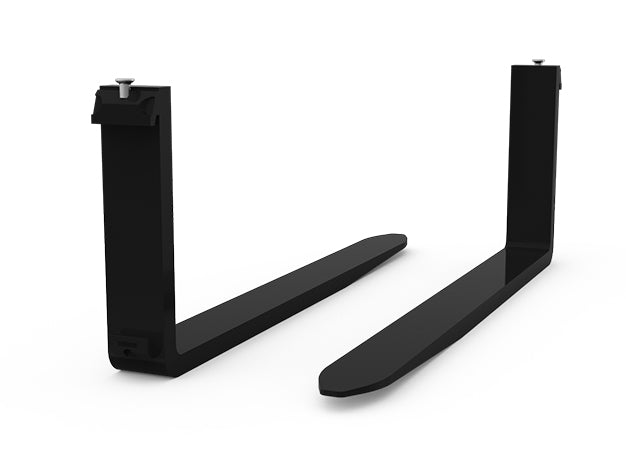
Shaft-mounted forks: match the machine, then the shafts. The telehandler side is where fit gets specific. These shaft-mounted forks suit pin-type carriages on telehandlers and rough-terrain forklifts, and Star Industries cuts distinct sets for named machine families: Skytrak, Lull, and JLG models, CAT TH-series units, Genie and Terex, Skyjack and Ingersoll Rand VR, Gehl RS and DL series, JCB, Gradall, and Xtreme reach machines. Each listing calls out the shaft diameter it fits, which ranges from about 2 inches up to 2.75 inches depending on the machine, so read the title against your carriage before you buy. Within a set you choose the fork dimensions, written as thickness by width by length by carriage reference, for example 2 by 5 by 48 by 28. Blades run from a compact single up to 96 inch pairs for long or bulky loads. Buying by machine name is the safe path here, but confirm the shaft size on your own carriage, since a family can span more than one shaft diameter.
Size the blade: thickness, width, length, and load center. Once the mount is settled, the blade dimensions do the rest of the work. Length should suit the load, not exceed it by much, because a fork far longer than the pallet wastes reach and pushes the load center out. Load center is the distance from the fork face to the center of gravity of the load, and a forklift is rated at a specific load center, commonly 24 inches on trucks up to 30,000 lb. Put a heavy load farther out on longer forks and the safe capacity drops, so longer is not automatically better. Thickness and width set the strength and the bearing surface: thicker sections carry more, wider blades spread the load and resist point damage. For pallet work, match the fork spacing and length to your pallet openings; for tall or dense unit loads, the shorter, stouter block fork keeps the weight close to the mast where the truck is most stable.
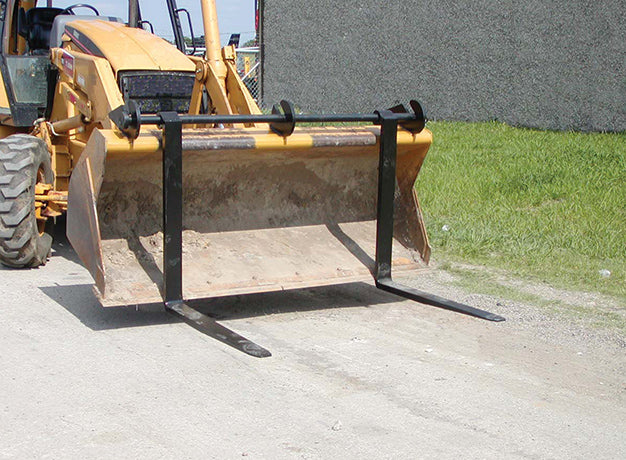
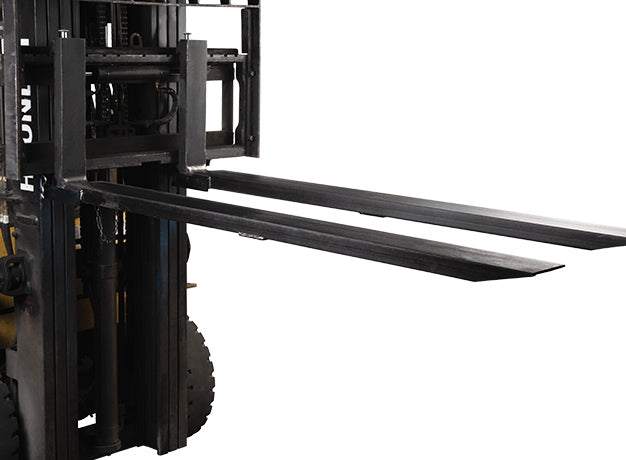
Extensions and over-the-bucket tines: adding reach to what you own. Two products here add fork capability without a new carriage. Fork extensions slide over your existing blades to reach deeper pallets or double-length loads, and they are the quick answer when a normal fork comes up short. There is a firm rule to respect: under OSHA and ANSI B56.1, a fork extension must not exceed 150 percent of the length of the supporting fork underneath it, so 42 inch forks accept extensions up to 63 inches and no more. The extension also has to seat fully and lock so it cannot walk off the blade. Over-the-bucket fork tines solve a different problem. The 42 and 48 inch complete sets clamp over a loader or tractor bucket, rated to 5,500 lb, and turn a machine that only has a bucket into one that can carry pallets. They earn their place on a farm or job site where a dedicated forklift is not on hand but a loader always is.
Capacity, the data plate, and inspection. Any fork you hang has to work inside the truck's rated capacity, and attachments change the math. OSHA 1910.178 requires the machine to carry a data plate that states the capacity, and when an attachment or non-standard fork is added, the employer needs updated capacity information from the manufacturer so the operator knows the real, usually lower, limit. Never read the original plate and assume it still holds after changing the forks. Inspection is the other habit that keeps forks in service safely. Check blades before use for cracks at the heel, where fatigue concentrates, and for bends, wear on the top face, and a set that no longer sits level. Measure heel thickness periodically, because a fork worn more than about 10 percent below its original thickness loses a disproportionate share of its rated capacity and should be retired. Keep the pair matched in length and height so the load rides flat, and confirm the latches or shaft collars hold the forks locked before every lift.
Frequently Asked Questions
They mount to completely different carriages and do not interchange. Hook-type ITA forks hang on a standard forklift carriage by engaging an upper and lower fork bar, and they are grouped by class, which is the carriage height. Shaft-mounted forks slide onto round shafts on a pin-type carriage, which is how telehandlers and rough-terrain forklifts hold their forks. Identify which carriage your machine has first, because it determines the entire set of forks that will fit.
The class equals your carriage height, the gap between the two fork bars. A 16 inch carriage is Class 2, a 20 inch carriage is Class 3, and a 25 inch carriage is Class 4. Class 2 generally covers trucks up to about 5,500 lb, Class 3 spans roughly 5,500 to 11,000 lb, and Class 4 handles the heaviest lift trucks above that. Measure your carriage and match the class.
Yes, within a limit. Slide-on fork extensions fit over your existing blades to reach deeper loads, but OSHA and ANSI B56.1 cap an extension at 150 percent of the length of the supporting fork beneath it. So 48 inch forks accept extensions up to 72 inches, and no longer. The extension must seat fully against the fork face and lock so it cannot slide off in use.
It depends on the item, so read the listing. ITA pallet forks and most shaft-mounted sets are priced as a pair, while ITA block forks are sold each, meaning a two-fork job needs two of them. Several shaft-mounted listings also offer a single blade option alongside the pair for replacing one damaged fork. The over-the-bucket tine sets ship as a complete set.
It can, and you have to account for it. Under OSHA 1910.178, the truck must carry a data plate stating its capacity, and when an attachment or non-standard fork is added, the employer needs updated capacity information from the manufacturer. A heavier or longer fork, or a load carried farther from the mast, lowers the safe limit. Never assume the original plate still applies after changing forks.
Buy by machine family, then confirm the shaft diameter. Star Industries cuts distinct sets for Skytrak, Lull, and JLG, CAT TH-series, Genie and Terex, Skyjack and Ingersoll Rand VR, Gehl RS and DL, JCB, Gradall, and Xtreme reach machines. Each listing names the shaft size it fits, from about 2 to 2.75 inches. Check the shaft diameter on your own pin-type carriage against the listing before ordering, since one machine family can span more than one shaft size.