Forklift Jib
A forklift jib turns the truck's forks into a crane, trading the flat load of a pallet for a hook that can sling an engine, a bundle of pipe, or a crated machine no fork can slide under. This collection runs the full range, from Vestil single-tine fork hooks at $91 up through telescoping booms that reach out several feet and Tandemloc fork beams rated to 10,000 lb on multiple pick points. The trade that governs every choice here is reach against capacity: the farther the hook sits from the fork face, the more the load's weight works as leverage against the truck, and the less it can safely lift. Brands include Vestil, Star Industries, Tandemloc, Morse, and Lift-All, at prices from under a hundred dollars for a bolt-on hook to five figures for a rated telescopic lifting beam. Read the reach math below before the hardware, because it decides what any of these can actually pick.
Compare Forklift Jibs & Hooks
| Model | Price | Capacity | |
|---|---|---|---|
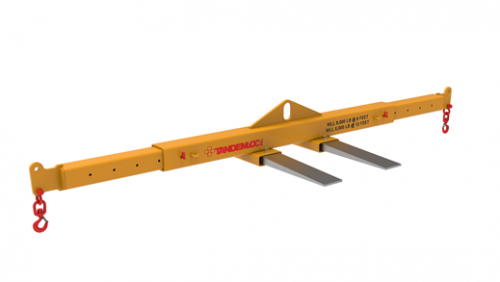
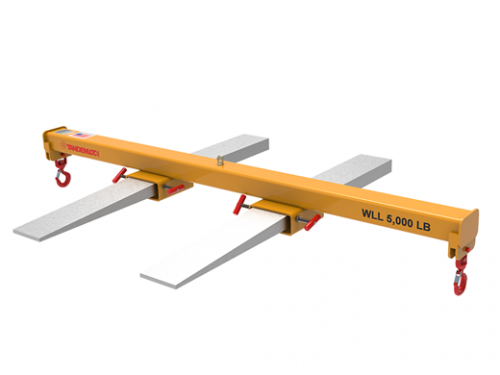
| Tandemloc Telescopic Forklift Lifting Beam | $5,883 | 5,000-8,000 lb | View → |
| Star Industries Heavy-Duty Jibs | $2,876 | 4,000-6,000 lb | View → |
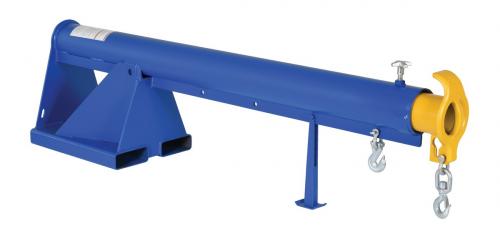
| Vestil Telescopic Forklift Boom with Tilt | $1,849 | up to 8,000 lb — derates to 750 lb; see load rating table | View → |
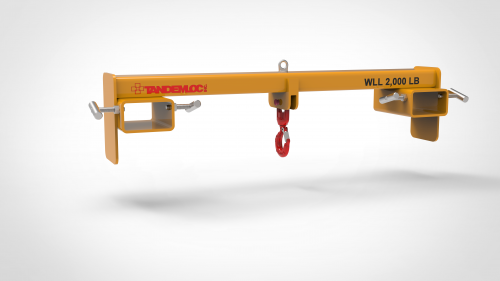
| Tandemloc AT38 Series Fork Boom | $1,575 | 2,000-5,000 lb | View → |
| Star Industries Universal Fit Lift Hooks | $1,454 | 10,000-22,000 lb | View → |
| Vestil Telescoping Forklift Boom | $1,317 | up to 8,000 lb — derates to 750 lb; see load rating table | View → |
 In Stock
 In Stock
 In Stock
 In Stock
 In Stock
 In Stock
 In Stock
 In Stock
 In Stock
 In Stock
 In Stock
 In Stock
 In Stock
 In Stock
 In Stock
 In Stock
Forklift Jibs & Hooks Buying Guide
Reach against capacity is the whole game. A forklift is rated at a load center, commonly 24 inches from the fork face, and a jib or boom moves the hook well past that line. Every inch the load hangs further out multiplies against the truck as a longer lever, so a boom reaching three feet can leave the truck lifting a fraction of its plated number even before the attachment's own weight is subtracted. Forklift and telehandler load charts do not compensate for this electronically; they simply print lower capacity at longer reach, and the same physics rules a fixed jib. That is why a 6,000 lb jib rating is a ceiling, never a promise: the truck's derated capacity at the hook position governs the pick. Work the number from your data plate at the reach you will actually use, not the attachment's headline rating.
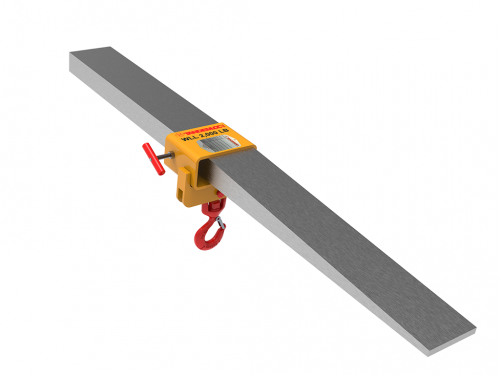
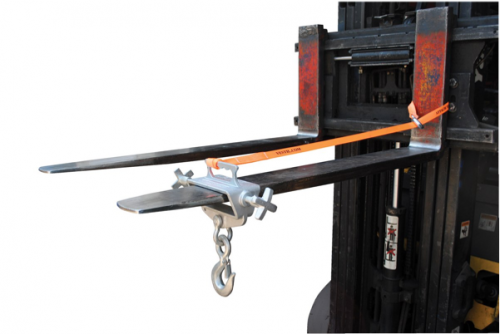
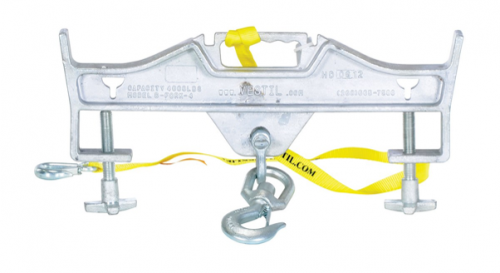
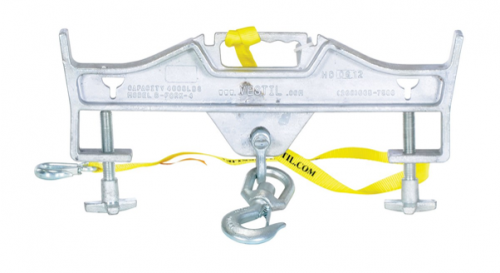
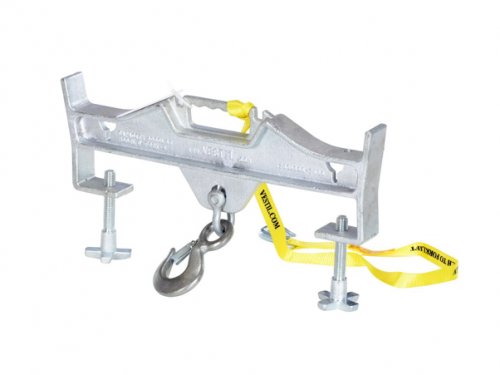
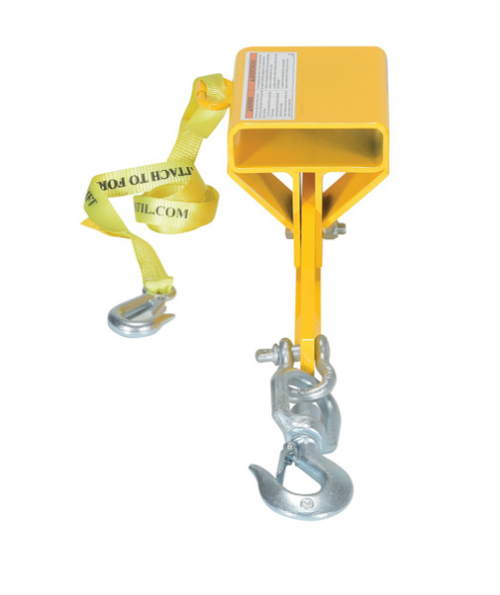
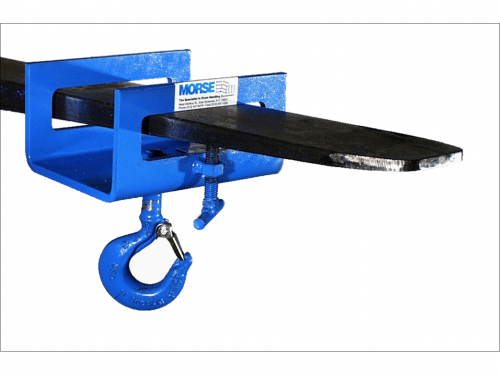
Fork-mounted hooks: the fast, cheap end. The simplest jib is a hook that mounts to a single fork. Vestil's single-tine hooks start at $91 with a rigid latch and run to about $176 with a swivel latch, while the wider units carry 4,000 lb from around $190 and 10,000 lb at about $332 in double swivel-latch form. Lift-All's alloy swivel grip hooks, $124 to $320, size to 4, 5, 6, and 8 inch forks in one and two ton ratings with an optional latch, and Morse's 284 series hook, $155 to $508, fits standard or large fork pockets for drum and general slinging. These slide or bolt on and let a fork truck sling a load in minutes, but the hook and fork have to be secured so they cannot be accidentally dislodged, which is a hard rule under the cargo handling standards rather than a suggestion.
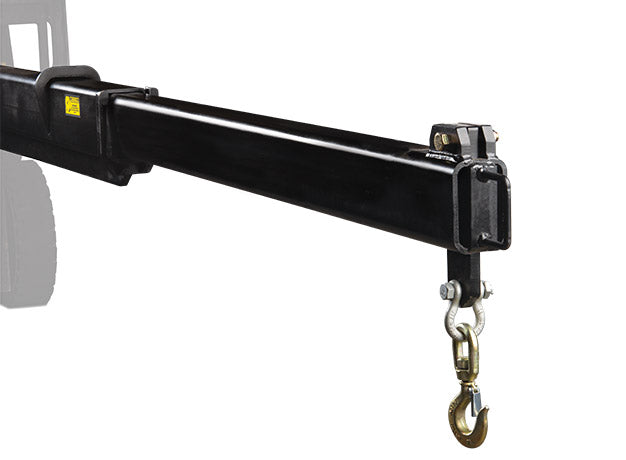
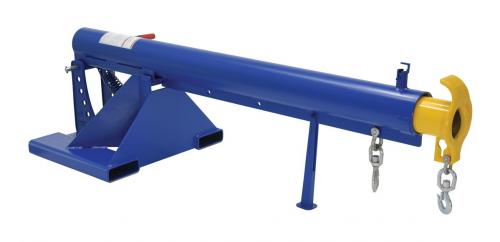
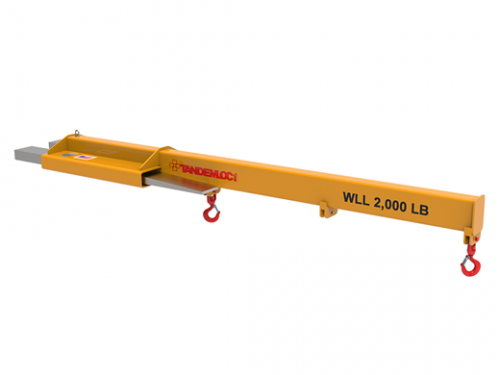
Telescoping booms and jibs: reaching past the forks. When the pick needs to clear an obstruction or set a load out away from the truck, a boom is the answer. Vestil's telescoping forklift boom, about $1,300 to $2,445, extends to put the hook where forks cannot go in 3,000 to 8,000 lb ratings across several fork pocket centers, and the tilt version, roughly $1,850 to $3,390, angles the boom to level an awkward load. Tandemloc's AT38 fork boom, $1,575 to $3,546, publishes its rating by maximum hook position, 2,000 lb out to 84 inches and 5,000 lb at 96 inches, which puts the reach-versus-capacity trade right on the spec line. Star Industries' heavy-duty jibs carry 6,000 lb in 5, 6, and 7 foot fixed lengths plus a 7 to 12 foot adjustable model from about $2,076. On any telescoping unit, confirm the rating at the exact extension you plan to lift at.
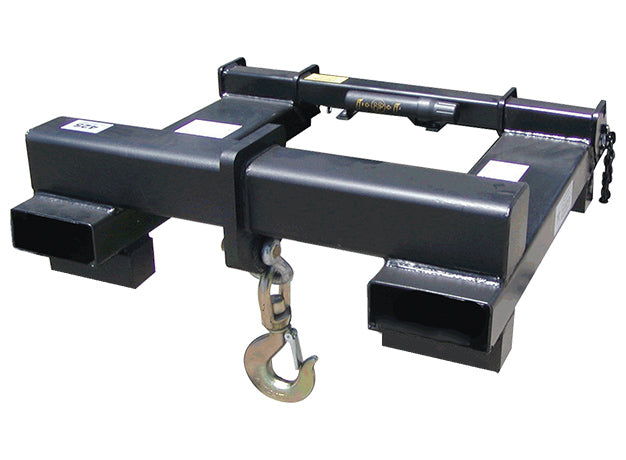
Fork beams and multi-pick attachments. For loads that need more than one pick point or a rated beam below the forks, the fork beam family takes over. Tandemloc's AS24 single fork lifting beams, $286 to $335, slide onto one fork and give a rated pick at 2,000 lb across three fork widths. The AT37 double-fork double-hook beam, $905 to $2,151, spreads two hooks 30 to 72 inches apart at 2,000 to 10,000 lb for long or two-point loads; the single hook type attachment runs 2,000 to 15,000 lb in 24 to 48 inch lengths, and the telescopic forklift lifting beam carries 5,000 lb at about $5,883. These are below-the-hook lifting devices in the ASME B30.20 sense, so they ship marked with a serial number and rated load, and those markings have to stay legible through the device's service life.
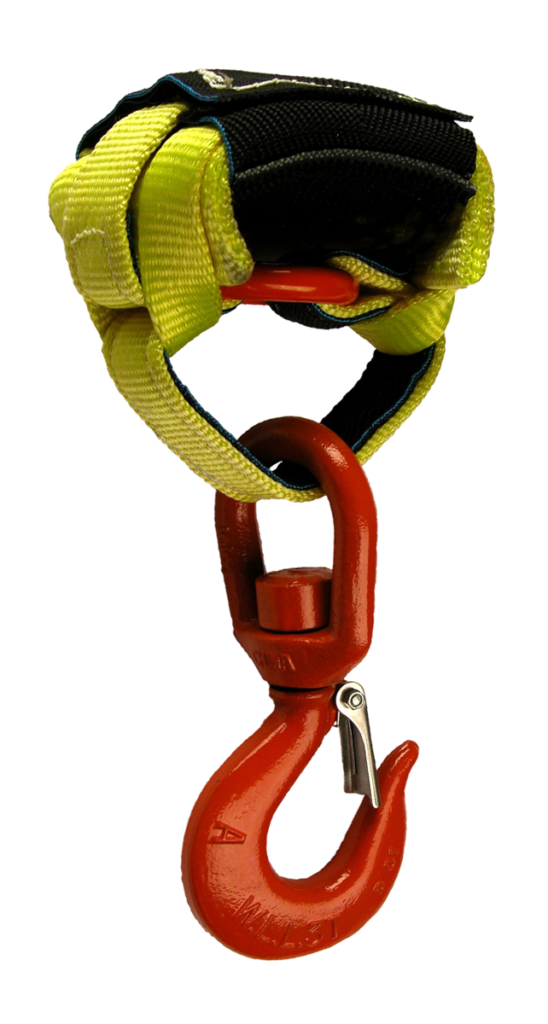
Securing the attachment, and reading the latch and swivel. Two details separate a safe jib pick from a near miss. First, secure the attachment: a fork-mounted hook or beam has to be positively retained against the forks with the maker's pin, chain, or heel strap so it cannot slide off during travel or tilt, since the cargo handling rules require forks and other attachments to be secured against accidental dislodgement. Second, know your latch and swivel. A spring latch bridges the hook throat to keep a sling from jumping out under slack; a swivel lets you orient the hook to the load before the pick. A positioning swivel is built to align the hook, not to spin a suspended load, so if the job needs the load to rotate under tension, confirm the hook is rated to swivel loaded rather than assuming it. Below the hook, ordinary rigging rules take over: shackles and slings sized to the load and the sling angle math no different than under a crane.
The paperwork and the way the truck handles. Any of these jibs affects the truck's capacity and safe operation, which puts it squarely inside OSHA 1910.178. Adding one calls for the truck manufacturer's prior written approval under 1910.178(a)(4), and the truck has to be marked to show the attachment and the combined weight of truck and attachment at maximum lift height. A jib also changes how the truck handles: the load rides higher and further forward, swings on the hook where a pallet sat dead still, and raises the machine's own center of gravity, so the operator needs training on the truck as equipped and a slower hand on the tilt and travel. None of this is expensive or slow, and it is the first thing an inspector checks, so make the call to your dealer part of ordering the attachment.
Frequently Asked Questions
Less than its rating, almost always. The jib's plate number is a ceiling; the real capacity is the truck derated for the hook position. Because a boom or jib moves the load well past the standard 24 inch load center, the weight works as a longer lever against the truck, and capacity falls as reach grows. Run the math from your data plate at the reach you will lift at, and remember the attachment's own weight comes off the top as well.
A fork hook clamps to a single fork and gives one hook for quick slinging, cheap and fast. A telescoping boom extends the hook out in front of the truck to reach past obstructions or set a load away from the forks, with capacity that drops as it extends. A fork beam is a rated below-the-hook device mounted on the forks with one or more fixed pick points, like the Tandemloc AT37's two hooks at a 30 to 72 inch spread, for long or multi-point loads.
Yes. A jib affects capacity and safe operation, so OSHA 1910.178(a)(4) requires the truck manufacturer's prior written approval, and 1910.178(a)(5) requires the truck be marked to identify the attachment and show the combined weight of truck and attachment at maximum elevation. Contact your forklift dealer when you add one and get the data plate updated to reflect the combination.
With the maker's positive retainer, a pin, chain, or heel strap that locks the hook or beam to the forks so it cannot slide off during travel, tilt, or a sudden stop. The cargo handling standards require forks, fork extensions, and other attachments to be secured against accidental dislodgement, so never run a fork hook or beam that only rests loose on the tines.
Only if the hook is rated to rotate under load. Many swivel hooks are positioning devices, built to let you orient the hook to the load before the lift, not to spin a suspended load under tension. Check the maker's rating before relying on a hook to turn a hanging load; if the job needs true rotation under load, use a hook or swivel built and rated for it.