Lifting Magnets
Lifting magnets grip a steel load through its face, so a plate, block, or round bar with no lift point and no edge to clamp still hangs cleanly from the hook. This collection covers permanent, lever-operated lifters, the kind you switch on and off by hand with no power, no battery, and no cord. It runs on MagMate's rare earth and ceramic ranges, from a compact DynamicLift for light plate up to the PowerLift line that reaches 5,000 lb, with Vestil filling the lighter flat-stock end. Entry units start around $316 and climb into four figures as capacity grows. Every magnet here is a below-the-hook lifting device under ASME B30.20, built to a 3:1 design factor, and every one of them is rated on clean, flat, thick, low-carbon steel, which is almost never the steel in front of you. The guide below covers the two things that decide whether a magnet is safe on your load: how it holds, and how much you have to derate the number on the nameplate.
Compare Lifting Magnets
| Model | Price | Capacity | |
|---|---|---|---|
| MagMate CreativeLift Permanent Lifting Magnets | $587 | 400-3,000 lb | View → |
| MagMate DynamicLift Rare Earth Permanent Lifting Magnet | $558 | 150-334 lb | View → |
| Vestil Lifting Magnet | $492 | 600-1,200 lb | View → |
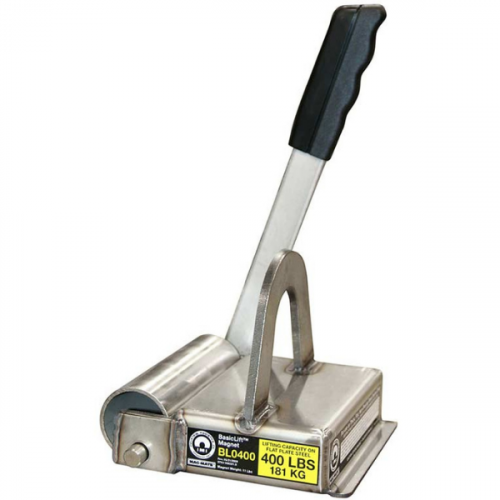
| MagMate BasicLift Permanent Ceramic Lifting Magnets | $442 | 400-1,500 lb | View → |
| MagMate PowerLift Permanent Rare Earth Lifting Magnets | $316 | 250-5,000 lb | View → |
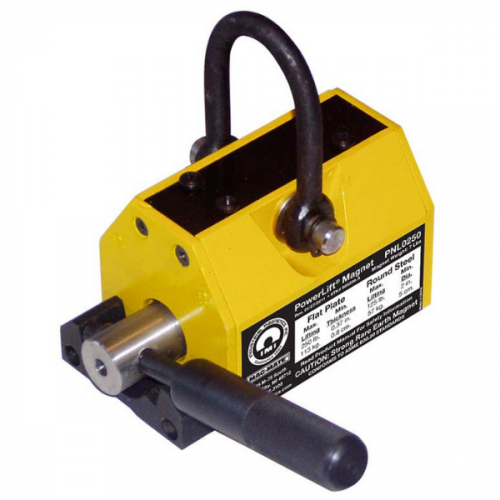 In Stock
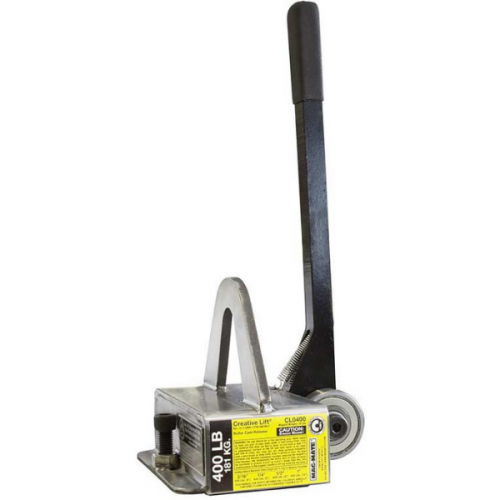 In Stock
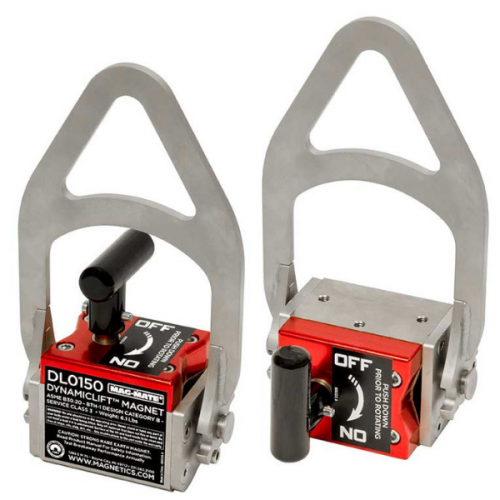 In Stock
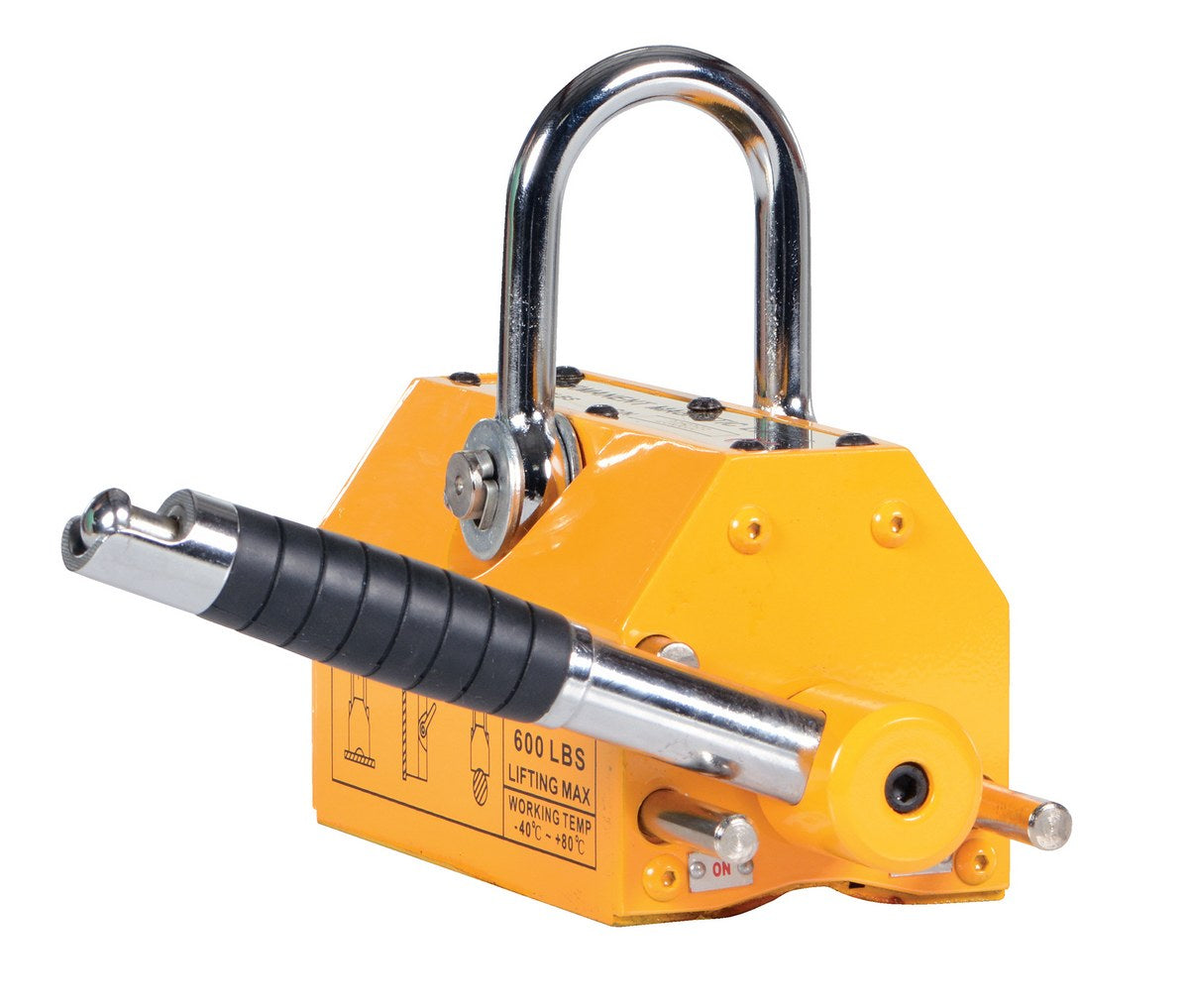 In Stock
 In Stock
Lifting Magnets Buying Guide
How a permanent magnet holds, and why breakaway is not capacity. A permanent lifting magnet has two magnet assemblies inside, and rotating the lever either lines up the poles to drive flux through the load, which is ON, or short-circuits the field internally, which is OFF. There is no power involved, so the magnet cannot let go because a battery died or a cord was cut, and that is the main reason shops choose permanent magnets over electromagnets for single-piece handling. The force it takes to peel the magnet straight off the steel is the breakaway force. The marked capacity, the working load limit, is a fraction of that. ASME B30.20 sets a 3:1 design factor for permanent magnets, so a magnet rated 1,000 lb does not release until somewhere near 3,000 lb of straight pull. That margin exists to cover peel, because a load applied at an angle or one that swings and pries at an edge peels far more easily than a straight vertical pull. Keep the pull vertical and the load balanced under the magnet.
The nameplate is a best case, so derate for your steel. The rating assumes clean, flat, low-carbon steel thick enough to absorb the full magnetic field, commonly a couple of inches on the larger models. Real steel costs you capacity on every count. Thin plate cannot carry the whole field, so a magnet on half-inch stock holds a fraction of its nameplate. An air gap from paint, rust, mill scale, or a rough surface drops the hold further, because magnetic force falls off fast with distance. Alloy and high-carbon steel hold less than mild steel. Treat these as multipliers stacked together: nameplate times a thickness factor times a surface factor, so a 1,300 lb magnet on thin coated plate can be worth closer to 700 lb in the real world. Every maker publishes a derate chart for exactly this, and the honest way to buy is to size the magnet for your worst case, thin, coated, and hard, not for the clean test coupon.
Flat stock and round stock are two different ratings. A magnet built for plate makes full face contact with flat steel. Put it on a round bar or pipe and the two touch along a thin line instead, so the hold collapses to roughly 30 to 50 percent of the flat rating. Magnets meant for round work carry a V-groove in the pole face that cradles the bar and restores two lines of contact, and many general-purpose lifters, MagMate's included, combine a flat face with a V-step so one magnet handles plate and round stock at separate, clearly marked ratings. Read the round number, never the flat one, when the load is a shaft, billet, or pipe, and keep the bar seated in the groove. Long round stock also wants two magnets spread along its length so it does not sag and peel off one end.
Rare earth or ceramic. The choice between rare earth, which is neodymium, and ceramic, which is ferrite, is a trade of holding power against heat and cost. Rare earth packs far more force into a given size, so PowerLift and DynamicLift reach their ratings in a smaller, lighter body: PowerLift climbs from 250 lb to 5,000 lb across five sizes, and DynamicLift covers compact 150 and 334 lb picks for light plate and fab work. Ceramic gives up strength per pound but costs less and tolerates more heat, and the BasicLift ceramic line covers 400 to 1,500 lb, with CreativeLift bridging the middle from 400 lb through 3,000 lb. One heat caveat matters: standard neodymium starts losing strength above about 176 F and can be permanently weakened by real heat, so steel coming off a torch table or out of heat treat belongs on a magnet rated for it, or off magnets entirely.
Match the magnet to the job. Size runs from the bench to the plate rack. For light plate, angle, and general fabrication, the compact rare earth DynamicLift at 150 and 334 lb and the ceramic BasicLift from 400 lb are the everyday picks, and the Vestil lifter covers the lighter flat-stock end at 600 and 1,200 lb from around $492. For one magnet that spans most of a shop's work, the PowerLift 250 to 5,000 lb ladder from $316 is the workhorse, and CreativeLift fills the 2,200 and 3,000 lb steps where BasicLift stops. A magnet is the right tool when the load has no lift point and no edge to grab. When the load does have a clean top edge, a vertical lifting clamp grips it mechanically with no derate math, and the wider family of plate and beam grabs lives under lifting clamps. Plenty of plate shops keep both and reach for whichever the specific piece rewards.
Below the hook: inspect it, keep the face clean. A lifting magnet is a below-the-hook device, so it carries the same discipline as your slings and shackles under ASME B30.20: a legible capacity marking, a documented inspection before use, and removal from service the moment it is damaged. The pole face is the whole machine. A nick, a burr, or trapped grit becomes an air gap that quietly steals capacity, so keep the face clean and unmarred and store the magnet so nothing rides against it. Never carry a load over people, never exceed the rating for the actual material and thickness in front of you, and turn the lever to OFF only after the load is landed and supported. Handle the derates honestly and a permanent magnet is one of the fastest, safest ways to move steel that fights every other rig.
Frequently Asked Questions
Less than the nameplate, usually by a wide margin. The rating assumes clean, flat, low-carbon steel thick enough to absorb the full field. Thin plate, paint or rust, a rough surface, and alloy steel each cut the hold, and the effects stack. Use the maker's derate chart, size for your worst-case material, and confirm the number for the actual thickness before you lift.
No. You switch them on and off with a hand lever that rotates the internal magnets. Nothing plugs in and there is no battery, so the magnet cannot drop a load because power failed. That is the main reason shops pick permanent magnets over electromagnets for handling one piece at a time.
Only at a steep discount. A flat magnet touches a round load along a thin line, so it holds roughly 30 to 50 percent of its flat rating. Use a magnet with a V-groove pole cut for round stock, read the round rating rather than the flat one, and put long stock on two magnets so it does not sag off one end.
Rare earth, meaning neodymium, delivers more capacity in a smaller, lighter body, which is why PowerLift and DynamicLift are rare earth. Ceramic, meaning ferrite, costs less and tolerates more heat but needs more size for the same pull. For most cool, dry steel handling the rare earth models are the efficient pick, and ceramic makes sense on a budget or where heat is a factor.
They are below-the-hook lifting devices under ASME B30.20, with structural design to BTH-1. Permanent lifting magnets are built to a 3:1 design factor, meaning the straight-pull breakaway force is at least three times the marked working load. That margin covers peel and misuse. It is not extra capacity to spend.
Standard neodymium lifting magnets start losing strength above about 176 F and can be permanently weakened by higher heat, so keep them on cool steel unless the model is rated hot. Ceramic tolerates more temperature but holds less per size. For parts off a torch table or out of heat treat, verify the magnet's temperature rating first or use another rig.