Moving Pads
Moving pads are the quilted blankets that ride between a finished surface and everything that would scuff it: the strap, the dolly rail, the next crate over, the trailer wall. This page carries Vestil's QPC-7280 line, one pad measuring 72 inches wide by 80 inches long, offered in three duty grades and in single, four, or twelve pad packs. General duty is cotton for indoor moves, all-weather is a water and mildew resistant polyester for damp docks and open trailers, and heavy-duty pairs cotton on one face with polyester on the other for jobs that see both. Prices run from under twenty dollars for a single pad to a little over two hundred for a twelve pack, so most operations buy by the bundle. The guide below sorts out which grade and how many.
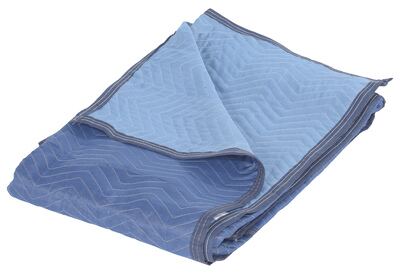
Moving Pads Buying Guide
One pad, three duty grades. Everything on this page is the same 72 by 80 inch quilted pad in three constructions. General duty is a cotton pad built for clean indoor work, moving furniture, cabinets, and cased goods across a warehouse. All-weather swaps the facing for a polyester that resists water and mildew, the grade to buy if pads live in an open trailer, cross a damp dock, or get stored somewhere that is never quite dry. Heavy-duty puts cotton on one side and polyester on the other, so a single pad offers both a soft indoor face and a weather-tolerant one. Single-pad prices track that order: cotton is cheapest, the polyester and combination grades cost a few dollars more.
Match the grade to the environment. The choice is mostly about moisture and abrasion, not the value of the load. A cotton general-duty pad is soft, drapes well, and is kind to polished and painted surfaces, but wet cotton stays wet and can grow mildew, so keep it indoors. Polyester all-weather pads shed water and dry fast, the reason they are the default for anything crossing a yard or sitting in a trailer overnight. If one pool of pads has to cover both worlds, the heavy-duty combination pad is the hedge: cotton face against the finish, polyester out toward the weather.
How the pad earns its keep. A moving pad does three jobs. It cushions, so a machine casting or an appliance does not chip when it shifts against a trailer wall. It spreads, so a ratchet strap or a chain does not print its edge into a soft panel; drape the pad under the strap at every contact point. And it separates, so two items nested on a truck do not rub each other bare in transit. Wrap corners and edges first, since that is where damage starts, then hold the pad in place with the strap or a wrap of stretch film.
Sizing and how many to buy. At 72 by 80 inches, one pad opens to roughly forty square feet, enough to wrap a full-size appliance, a desk, or the face of a pallet. Most items need more than one, so pads sell in singles for a spot need, four-packs for a truck or a small crew, and twelve-packs for a shipping department that pads every load. A twelve-pack of general-duty cotton weighs about 57 pounds and the all-weather polyester about 63, so a bundle is a two-hand carry. For the equipment that gets the load to the truck, see the rest of the loading dock equipment.
Care keeps the quilt working. Quilted pads last for years if they are laundered and stored dry. Cotton general-duty pads can be washed but take longer to dry and should never go back on the shelf damp. Polyester all-weather pads wash and dry quickly and tolerate the wet-then-stored cycle that ruins cotton. Fold and stack pads off the floor between jobs, keep them out of forklift traffic, and retire any pad whose quilting has torn open and started shedding fill, because a pad that has lost its loft has lost its cushion.
Frequently Asked Questions
Every pad in the QPC-7280 line is 72 inches wide by 80 inches long, about forty square feet open. The line comes in three duty grades and in single, four, and twelve-pad packs.
General duty is a cotton pad for clean indoor moves. All-weather is a polyester pad that resists water and mildew, made for damp docks and open trailers. Heavy-duty combines a cotton face and a polyester face so one pad works in both settings.
The all-weather polyester grade (QPC-7280-UP) is water and mildew resistant. The general-duty cotton grade is not, so keep it indoors and store it dry.
One pad wraps a single appliance, desk, or pallet face. Buy singles for a spot need, four-packs for a small crew or one truck, and twelve-packs for a route or shipping department that pads every load.
Yes. Drape a pad under any strap, chain, or binder where it contacts the load so the tension does not print an edge into a soft or finished surface. Wrap corners and edges first, since that is where damage starts.
Launder them and always store them dry and off the floor. Polyester pads wash and dry fast; cotton takes longer and must not be shelved damp. Retire any pad whose quilting has torn and started shedding fill.