Car Tie Down Straps
If you searched for car tie down straps expecting something to lash a vehicle onto a trailer, read this first. The straps in this collection are Lift-All ResQ-All recovery and towing straps, built to pull a stuck or disabled vehicle in a straight line, not to hold one down for transport. They are loop-end polyester straps with no metal hooks, made from high-tenacity Tuff-Edge III webbing, and offered in 1-ply and 2-ply builds from 2 to 12 inches wide and 16 to 30 feet long. Each strap carries both a lifting working load limit and a separate straight-line towing rating. If you actually need to secure a vehicle for hauling, the guide below points you to the right cargo-control gear instead of guessing.
Compare Vehicle Straps
| Model | Price | Ply | Web Material | |
|---|---|---|---|---|
| Lift-All ResQ-All 2-Ply Tuffedge III Polyester Towing & Lifting Vehicle Straps | $66 | 2 | Tuff-Edge III Polyester | View → |
| Lift-All ResQ-All 1-Ply Tuffedge III Polyester Towing & Lifting Vehicle Straps | $49 | 1 | Tuff-Edge III Polyester | View → |
Vehicle Straps Buying Guide
This is a recovery strap, not a cargo tie-down. The label vehicle straps covers two different jobs, and the ResQ-All handles only one of them. It is a recovery and towing strap: you use it to pull a vehicle that is stuck, disabled, or off the road, with the load running straight through the strap in a line. It is not a tie-down for holding a car flat on a trailer bed. If that is the job you came for, the ratchet and cam straps, wheel nets, and axle straps in ratchet straps and the wider cargo control and tie-downs hub are the correct gear, and those carry the FMCSA working-load-limit markings a roadside inspection looks for. A recovery strap and a tie-down fail in opposite directions, so buy the one that matches the task.
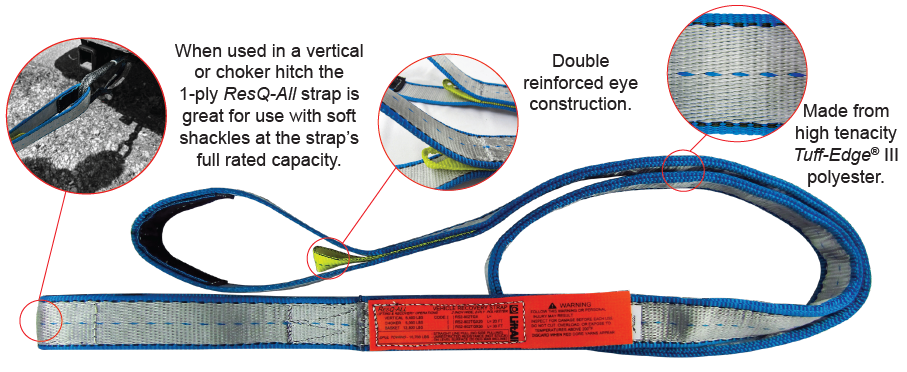
One ply or two. Both ResQ-All straps are the same Tuff-Edge III polyester in the same widths, so the ply count sets the strength and the price. The 1-ply strap starts around $49 and is the lighter, more packable choice for lighter vehicles and routine recovery. The 2-ply strap starts around $66 and adds a second layer of webbing for higher capacity and more abrasion life on heavy trucks and equipment. One detail matters if you rig with soft shackles: the 1-ply strap keeps its full rated capacity in a vertical or choker configuration with a soft shackle, while a 2-ply strap or any basket hitch takes a 50 percent reduction when a soft shackle is in the connection. If soft shackles are part of your kit, that changes which ply actually gives you more usable strength.
No hooks, and that is deliberate. Every ResQ-All ends in a reinforced polyester eye, not a metal hook. A recovery strap under tension stores enormous energy, and a steel hook that lets go becomes a projectile, while a soft loop does not. Each eye is Cordura-lined at the bearing point to resist the wear that kills straps at the connection, and the webbing is Tuff-Edge III, an edge-protected polyester that stands up to dragging over a bumper or frame. Connect the loops with a rated soft shackle or a properly seated recovery point, keep everyone clear of the pull line, and never join two straps with a metal clevis in the middle.
It is rated to lift, too. The full product name is towing and lifting for a reason. Each ResQ-All is dual-rated, carrying a straight-line towing rating for recovery and a separate working load limit for use as a lifting sling in vertical, choker, and basket hitches. That makes it a real crossover with the loop-eye web slings in our lifting slings range, so a recovery strap that lives in the truck can double as a soft sling on a light lift. Read the tag before you rig: the towing number and the lifting WLL are different figures, and using the towing rating for an overhead pick is a serious mistake.
Match the width and length to the pull. Widths run 2 to 12 inches and lengths run 16 to 30 feet across both plies, with per-size pricing climbing to roughly $980 for the widest, longest 2-ply strap. Wider webbing spreads the load and raises capacity, while a longer strap gives you standoff distance between the two vehicles on a recovery. Size the width to the weight you are pulling and the length to how far apart the anchor points sit.
Frequently Asked Questions
No. The ResQ-All is a recovery and towing strap for pulling a vehicle in a straight line, not a tie-down for securing one during transport. For that, use ratchet straps with wheel nets or axle straps, which carry the FMCSA working-load-limit markings an inspection requires. See our [ratchet straps](/collections/ratchet-straps) and the [cargo control and tie-downs](/collections/truck-tow) hub.
Both use the same Tuff-Edge III polyester in the same widths, so ply sets strength and price. The 1-ply is lighter and starts around $49; the 2-ply adds a second webbing layer for higher capacity and more abrasion life and starts around $66. With soft shackles, the 1-ply keeps full rated capacity in a vertical or choker hitch, while a 2-ply or basket hitch takes a 50 percent reduction.
A strap under recovery tension stores a large amount of energy, and a metal hook that releases can fly loose and injure someone. The ResQ-All uses reinforced polyester eyes at each end instead, connected with a rated soft shackle or a proper recovery point. Keep bystanders clear of the pull line during any recovery.
Yes. It is dual-rated, with a separate working load limit for use as a lifting sling in vertical, choker, and basket hitches alongside its towing rating. Read the tag and use the lifting WLL, never the towing number, for any overhead pick. See our [webbing slings](/collections/webbing-slings) for dedicated lifting options.
Widths from 2 to 12 inches and lengths from 16 to 30 feet, in both 1-ply and 2-ply builds. Pricing is per size and rises with width and length, up to roughly $980 for the widest, longest 2-ply strap.