What a full-body harness is
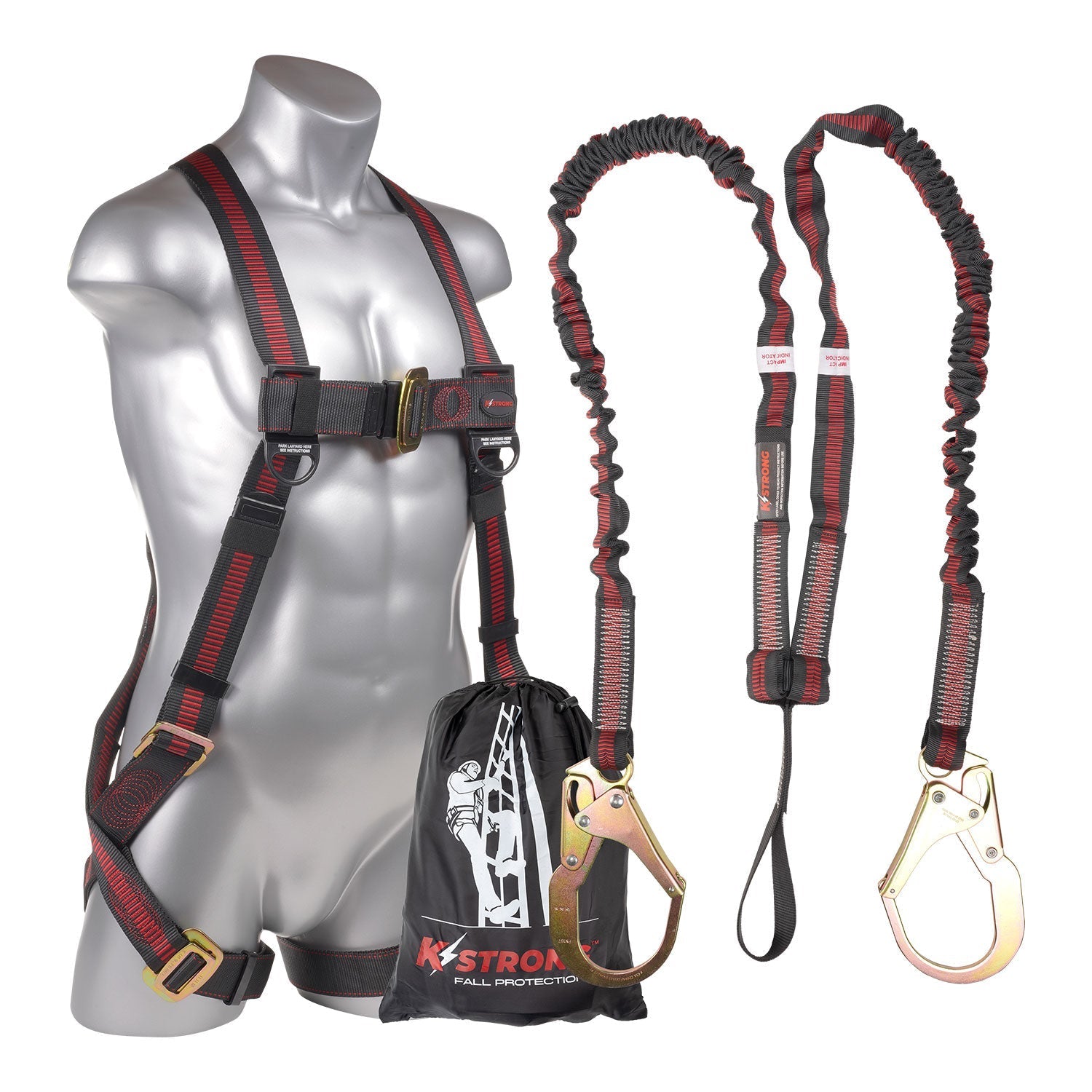
A full-body harness is the piece of fall protection a worker actually wears, a system of webbing straps that go over the shoulders, around the chest, and around the thighs, connected to load-bearing D-rings and secured with buckles. Its job is to catch the worker in a fall and spread the sudden arrest forces across the body's strongest areas rather than any one vulnerable point. Together with an anchorage and a connector, it forms a Personal Fall Arrest System. Our full-body harnesses are ANSI-rated units built for exactly this life-safety role.
Why full-body, not a body belt
This is a critical safety point: only a full-body harness is acceptable for fall arrest, and body belts are prohibited for it. A body belt wraps only the waist, so in a fall it concentrates the entire arrest force on the abdomen and lower spine, which can cause severe internal injuries or death even if the fall is stopped. A full-body harness instead distributes that force across the shoulders, chest, and thighs, keeping the worker upright and intact. OSHA's fall-arrest standards require a body harness, not a belt, for this reason. Never use a body belt for fall arrest; it's both non-compliant and dangerous.
The parts of a harness
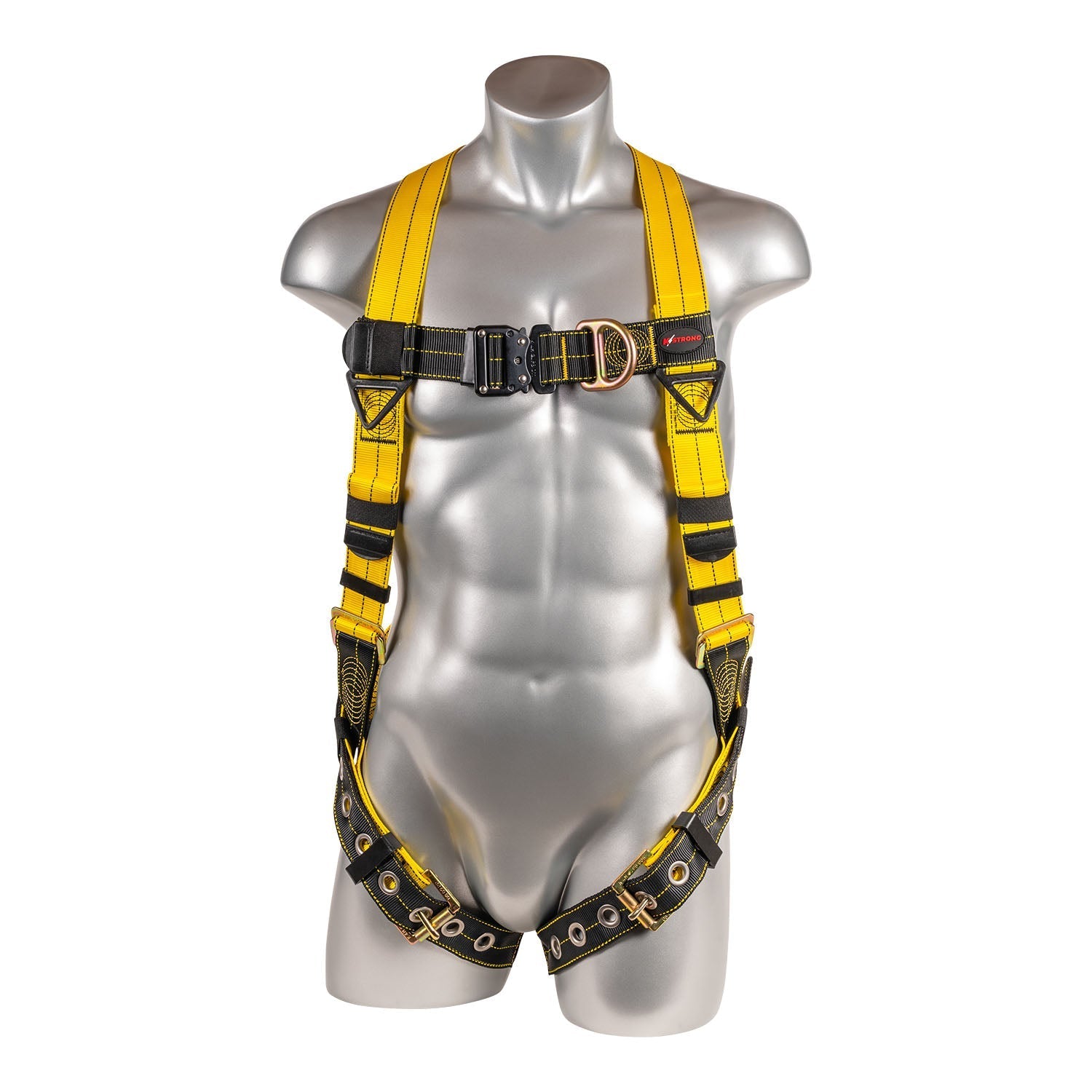
A full-body harness has a few key components. The webbing is the strong synthetic strapping that forms the harness and bears the load. The D-rings are the metal attachment points, the dorsal (back) D-ring is the main one for fall arrest, and harnesses may add chest (sternal), hip (side), or shoulder D-rings for other uses. The buckles, various quick-connect, tongue, or pass-through designs, secure and adjust the straps. And labels carry the rating and inspection information. Each metal part and the webbing is rated, and the harness as a whole must be intact and correctly adjusted to protect the worker.
D-ring positions and their uses
Where you clip in on a harness depends on the D-ring, and using the wrong one is a serious error. The dorsal D-ring, between the shoulder blades, is the primary and OSHA-required attachment for fall arrest, it keeps the worker upright and distributes force correctly. The sternal (chest) D-ring is for ladder-climbing systems, controlled descent, rescue, and restraint, usable for arrest only when free fall is very limited (about 2 feet or less). The side/hip D-rings (a pair) are for work positioning only, never for fall arrest alone. And shoulder D-rings are for rescue and confined-space retrieval. Always clip your fall-arrest connector to the dorsal D-ring.
How to fit a harness correctly
A harness only protects you if it fits right. Put it on by the dorsal D-ring, shake out any twisted straps, then buckle and tighten the chest and leg straps gradually so the harness is snug but not binding, roughly one to two fingers should fit between a strap and your body. Critically, the dorsal D-ring must sit centered between your shoulder blades; you adjust it by sliding the D-ring plate up or down the back webbing. The chest strap sits mid-chest, and the leg straps are snug around the thighs without restricting movement. A loose harness lets you fall farther and can shift dangerously in a fall, so fit matters as much as the gear.
Harness classes and features
Harnesses vary by intended use and features. Beyond the basic fall-arrest harness with a dorsal D-ring, models add front (sternal) D-rings for ladder climbing and descent, side D-rings for positioning, and shoulder D-rings for retrieval, a five-point harness with multiple D-rings covers more applications. Other features include padded shoulders and legs for comfort, tool loops, quick-connect buckles for fast donning, and specialized webbing (like oil- and water-repellent treatment on our Kapture Element harness). Choose the harness whose D-ring configuration matches your work, arrest, positioning, climbing, or rescue, and whose comfort features suit long wear.
When to replace a harness
A harness is life-safety gear with a finite life. It must be removed from service immediately if it fails inspection, damaged webbing, stitching, or hardware, and always after it has arrested a fall, since a fall can compromise the harness even if damage isn't visible. Beyond that, harnesses have a service life influenced by use, storage, and exposure; UV, chemicals, and heat degrade webbing over time, so a harness that's old or heavily weathered should be retired even without obvious damage. When in doubt, take it out of service. A harness is cheap next to the consequence of one failing in a fall.
The bottom line
A full-body harness is the webbing body wear that catches a worker in a fall and distributes the arrest force across the shoulders, chest, and thighs, the only body support OSHA allows for fall arrest, since body belts are prohibited. Clip your fall-arrest connector to the dorsal (back) D-ring, fit the harness snug with the dorsal D-ring between your shoulder blades, and inspect it before every use. Retire it after any fall or when damaged. Learn inspection in our how to inspect a safety harness guide, compare models in best safety harnesses, and see the full fall protection guide.
Comfort matters for compliance
It's worth noting that a comfortable harness is a safer harness, because workers actually wear a comfortable one correctly and consistently. A harness that digs in, chafes, or restricts movement gets loosened, worn wrong, or taken off, defeating its purpose. That's why padding on the shoulders and legs, breathable webbing, and easy-adjusting buckles aren't just luxuries: for anyone wearing a harness all day, comfort features translate directly into consistent, correct use. When choosing a harness for a crew, weigh comfort alongside the rating and D-ring configuration, since the best harness is the one that gets worn properly every time.