The short version
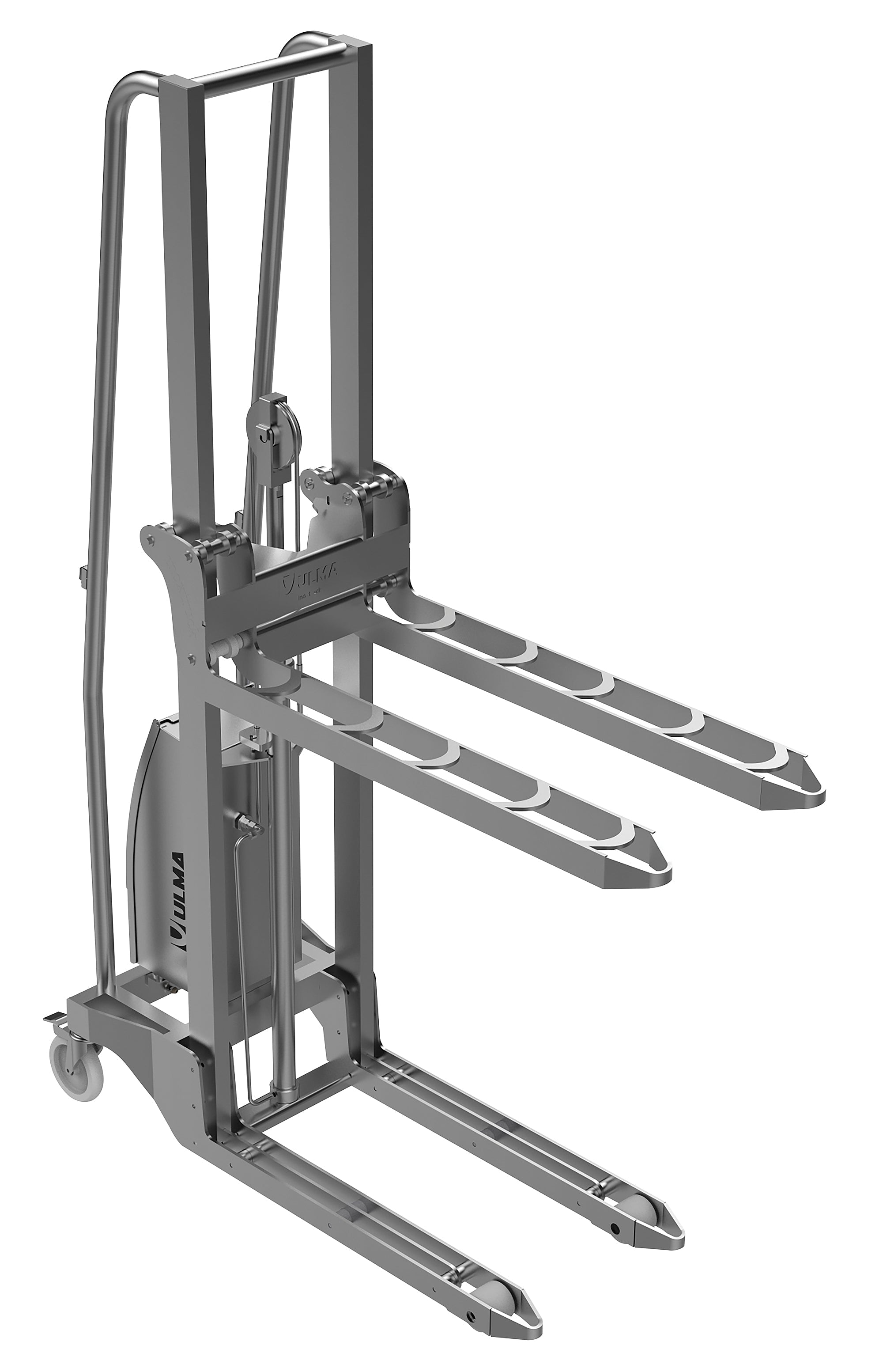
A pallet stacker, sometimes called a walkie stacker, is a compact machine that does what a pallet jack can't: lift a load up to height. Where a jack raises a pallet a few inches to roll it across the floor, a stacker has a vertical mast that lifts pallets onto racking, into trucks, or on top of other pallets, commonly to 50 to 150 inches. It's a walk-behind unit, quieter, cleaner, and cheaper than a forklift, and it fits in tight aisles. Think of it as the middle rung between a pallet jack and a forklift.
Pallet stacker vs pallet jack
This is the key distinction, and it's all about vertical lift. A pallet jack lifts only 7 to 8 inches, just enough to move a load at floor level. A pallet stacker adds a mast and lifts loads up to storage height, often 4 to 12 feet or more. If your job is moving pallets from A to B on the floor, you want a jack. If you need to put pallets up onto racks or pull them down, you need a stacker. We cover the full comparison in pallet stacker vs pallet jack.
The three power types
Stackers come in three flavors. A manual (hand) stacker uses manual push travel and a hand-pump hydraulic lift, the cheapest option, best for light, occasional stacking. A semi-electric stacker adds a powered lift while you still push it to move, giving roughly 80 percent of the functionality at about half the cost of full electric, which makes it the value sweet spot for many operations. A fully electric stacker powers both the drive and the lift, best for frequent, heavy, or long-distance work. Our electric vs manual pallet stacker guide covers which to choose.
Straddle versus counterbalance
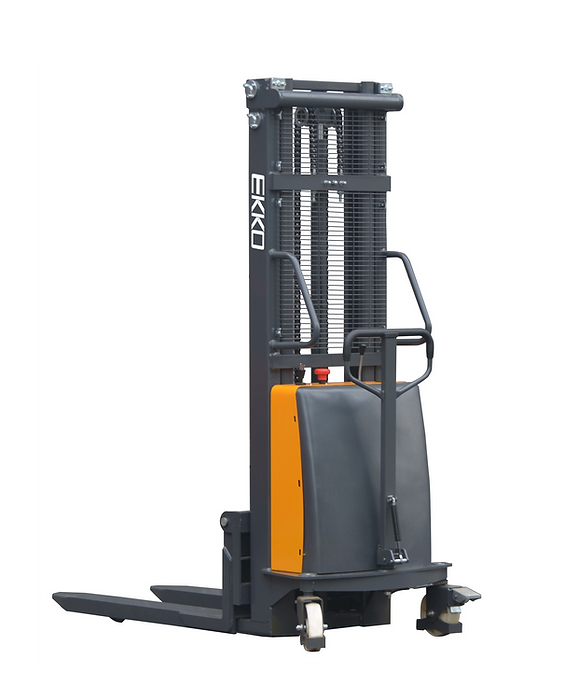
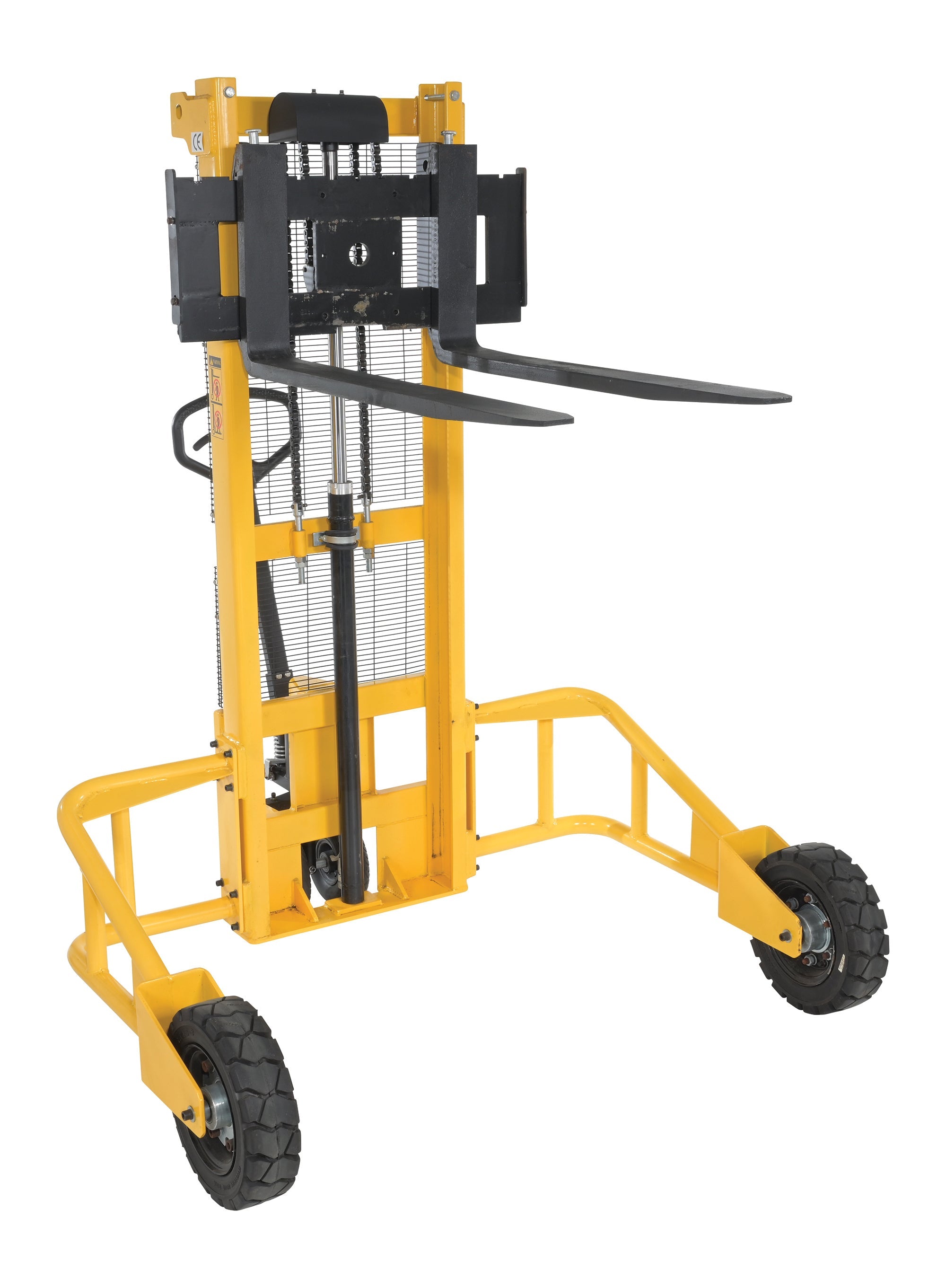
Stackers also differ in how they stay stable. A straddle stacker has front outrigger legs that straddle outside the pallet for balance, and adjustable-width legs, like on the EKKO EA15E, accommodate different pallet and skid sizes. A counterbalance stacker uses a rear counterweight instead of front legs, working like a compact forklift, which lets it handle closed or bottom-boarded pallets that legs can't fit around, at the cost of needing a wider aisle (roughly 8 to 10 feet). Straddle units are more common and more aisle-friendly; counterbalance units suit awkward loads.
How high a stacker lifts
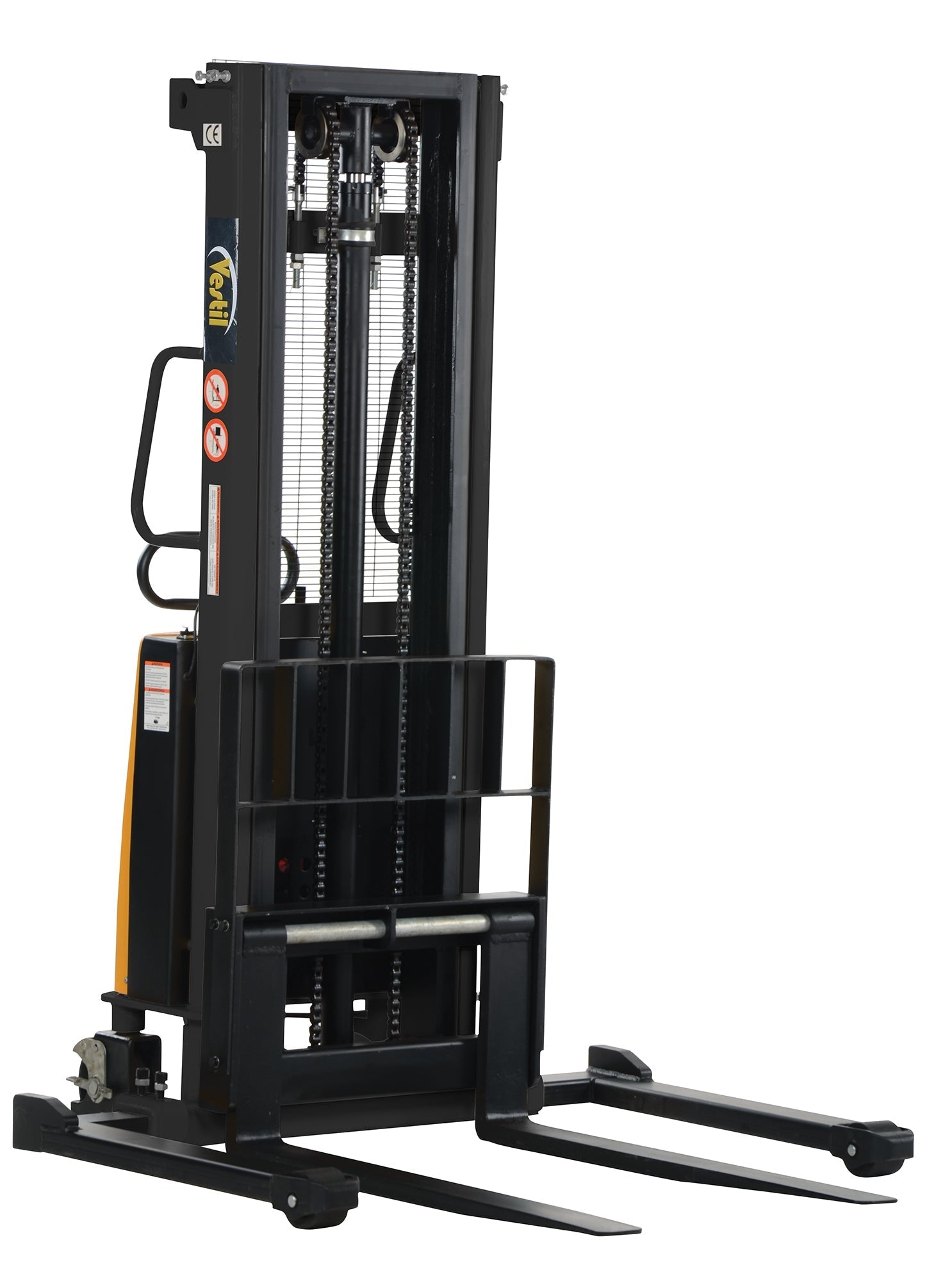
Lift height is a stacker's defining spec, and it ranges widely. Manual stackers sit at the low end, while powered models commonly reach 98 to 138 inches, and some go to 150 inches or beyond, roughly 15 feet. The EKKO EA15E lifts to 138 inches, and the Vestil electric powered stacker reaches 150 inches. Match the lift height to your top rack or storage level, with a little margin. For anything above about 15 feet, you're into forklift territory, since stackers top out where forklifts keep climbing.
Typical capacity
Walk-behind stackers commonly handle 1,000 to 4,000 lb. Light-duty manual and box stackers carry a few hundred pounds, semi-electric units like the EKKO EA15E handle around 3,300 lb, and heavier electric models climb from 1.5 tons up to 5 tons or more. As with any lifting equipment, choose a capacity that exceeds your heaviest load with margin, and never exceed the rating. Capacity and lift height together define what a stacker can do, so spec both against your actual loads and rack heights before buying.
Stacker vs forklift
A stacker and a forklift overlap but serve different needs. A forklift lifts higher (to around 30 feet), carries heavier loads, works indoors and out, and is ride-on. A stacker lifts to about 15 feet, is emission-free and quiet, fits narrow aisles, and costs far less. For tight indoor spaces, moderate loads, and moderate heights, a stacker is the smarter, cheaper tool. Step up to a forklift when you exceed a stacker's height or capacity, or need outdoor and rough-terrain capability. Many warehouses run both, stackers for tight indoor racking, forklifts for the heavy and high work.
Who uses a pallet stacker
Pallet stackers suit operations that need to put loads up but don't justify a forklift: smaller warehouses, stockrooms, retail back-rooms, workshops, and businesses with tight aisles or indoor-only work. They're popular where a forklift would be overkill, too big, too expensive, too loud, or where emissions rule out an internal-combustion truck. A single worker can stack pallets onto racking with a walkie stacker in spaces a forklift couldn't maneuver. For moderate-volume vertical storage in a compact footprint, the stacker is the tool that fits.
Choosing the right stacker
Start with three questions: how high do you need to lift, how heavy are your loads, and how often will you stack? Low, light, and occasional points to a manual stacker. Moderate height and weight with regular use favors a semi-electric unit like the EKKO EA15E, the value pick for most. Frequent, heavy, or long-distance work justifies a fully electric stacker. Then match lift height to your top rack and capacity to your heaviest load, with margin. Our best pallet stackers comparison lines up the options by type and spec.
The bottom line
A pallet stacker lifts pallets up a mast to storage height, filling the gap between a floor-level pallet jack and a full forklift. It comes in manual, semi-electric, and fully electric versions, in straddle or counterbalance designs, lifting to roughly 15 feet and handling 1,000 to 4,000 lb or more. For putting loads up in tight indoor spaces without a forklift, it's the right tool. Compare real models in our best pallet stackers guide, or browse the full stacker range.
Aisle width and space
A practical factor when choosing a stacker is how much room it needs. Straddle stackers, with their front outrigger legs, are narrow-aisle friendly and fit tight indoor spaces, one reason they're so popular over forklifts. Counterbalance stackers need more room, roughly 8 to 10 feet of aisle, because they lack straddle legs and work like a compact forklift. Either way, a stacker fits spaces a full forklift can't. Before buying, measure your narrowest working aisle and confirm the stacker you're considering can turn and operate there with a load.