Hydraulic Bottle Jack
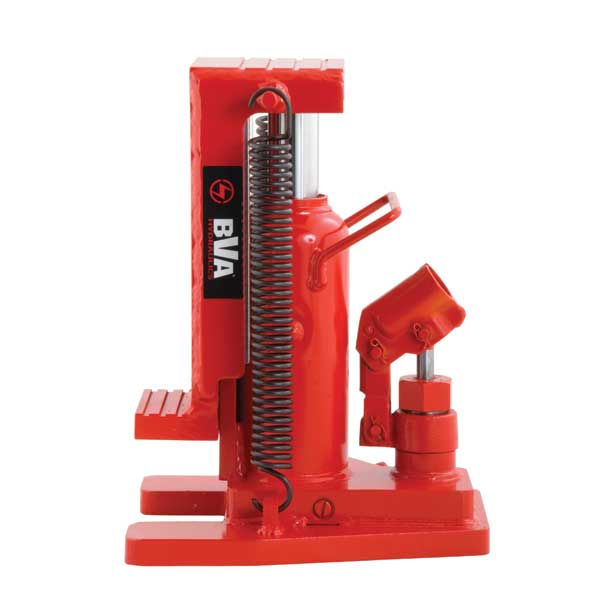
A hydraulic bottle jack lifts from a saddle on top of a vertical ram, which is the wrong shape for a machine that sits flat on the floor with no room to slide a saddle underneath. The industrial jack in this collection answers that problem from below: the BVA Hydraulics Magic Lift toe jack. Its patented lifting claw drops close to ground level, gets under a low load, and raises it on the toe or on the flat head up top, with the top pad rated higher than the toe. The JBT line runs 3, 6, 10, and 15 ton on the toe, from around $800 to just over $2,200, each a self-contained hydraulic jack you run by hand.
Hydraulic Jacks Buying Guide
Toe capacity and top capacity are two different numbers. Toe jacks carry two ratings, and the model number only tells you one of them. The label capacity, 3, 6, 10, or 15 ton across the JBT line, is what the low toe will lift down at floor level. The flat head on top of the ram is rated higher, generally close to double the toe figure, because the load then bears straight down over the cylinder instead of out on the claw. Size to whichever contact point you will actually use. If you are picking a machine base up by a lip an inch off the floor, that is a toe lift and the toe number governs. If you can get the head under a solid pad, you have more capacity to work with. Add margin over the real load either way, and round up to the next model.
Buy it for the clearance a saddle jack cannot reach. The reason to own one of these is the gap under the load. The BVA toe drops close to the floor and slides into an inch or two of clearance that a saddle-top jack cannot touch, which is why toe jacks live under forklifts, machine bases, transformers, and other low-profile equipment. The unit lifts vertically and can be laid on its side to push a load sideways when you need to nudge a machine into position. Once it has the load off the floor, you slot blocking or a moving skate underneath and set it back down. For the pumps, cylinders, hoses, and fittings that make up the rest of the BVA system, see Hydraulic Equipment. When a job needs straight vertical push with more stroke than a toe jack gives, the hydraulic cylinders run from 2 to 120 ton.
What the Magic Lift core is built from. BVA's patented Magic Lift mechanism raises the ram quickly while the jack is still under no load, so you close the gap to the machine fast and slow to a controlled crawl once weight comes on. A patented by-pass device stops the ram from over-traveling at the top of its stroke, which protects the seals from damage. The ram is chrome plated to keep the seals sealing over a long service life, and the cylinder is heat-treated medium-carbon steel. BVA rates the line for railroad, bridge construction, and general heavy machinery work, which is the duty these prices, roughly $800 to $2,200, are built to survive.
Frequently Asked Questions
No. A bottle jack lifts from a saddle on top of a vertical ram, which needs clearance above the load. The Magic Lift is a toe jack: it lifts from a low claw at the base as well as a flat head on top, so it can start a lift on a machine sitting almost flat on the floor. It shares the same hydraulic principle as a bottle jack but solves the low-clearance case a bottle jack cannot.
The model rating, 3 to 15 ton across the JBT line, is the toe capacity at floor level. The top head is rated higher, generally close to double the toe figure, because the load bears straight down over the cylinder. Confirm the head rating for the model you choose, and size to the contact point you will actually lift from.
Four models: JBT03 (3 ton) at about $809, JBT06 (6 ton) at about $1,053, JBT10 (10 ton) at about $1,252, and JBT15 (15 ton) at about $2,236. All four are stocked as single-jack units, and larger or wider loads use two jacks placed under opposite corners.
Yes. It lifts vertically and can be laid on its side to push a load horizontally, which is useful for shifting a machine into position after it is up off the floor. Follow BVA's orientation and load limits when you use it horizontally.
The patented Magic Lift mechanism raises the ram quickly while it is under no load, so you close the gap to the machine fast and finish under control once weight is on it. The patented by-pass device stops the ram from over-traveling at the top of its stroke, which keeps the hydraulic seals from being damaged.