Hydraulic Manifolds
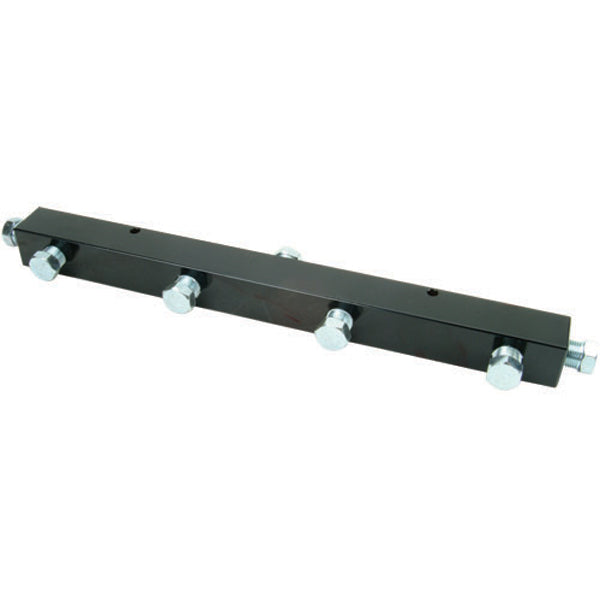
A hydraulic manifold is the junction block that takes one pressure line off a pump and splits it into several, so a single power unit can drive four or six cylinders at once instead of one corner at a time. This collection carries the BVA Hydraulics 7-port manifold block, a solid steel bar rated to the 10,000 psi standard that runs high-pressure hydraulics, in two lengths for tighter or wider port spacing. It is the part that turns a single-cylinder rig into a multi-point lift, and it is priced like a fitting rather than a machine. If you are jacking a load on four corners, leveling a machine base, or tensioning a ring of studs together, this is the piece that feeds them all from one pump.
Hydraulic Manifolds Buying Guide
What a manifold does in the line. A manifold is a steel block drilled with one inlet and a row of outlet ports on a common gallery, so oil arriving from the pump reaches every port at the same pressure. That is the whole trick behind a multi-point lift: one power unit feeds a bank of cylinders through the block, and each cylinder pushes with the same force because pressure is equal everywhere the oil can reach. Force is that pressure times each plunger's area, so matched cylinders on a manifold rise together as long as the load over each is roughly even. Without the block you are running one hose to one cylinder and lifting a corner at a time, cribbing between moves, which is slower and far easier to get out of level.
The BVA 7-port block, in two lengths. The manifold here is BVA's steel bar with seven 3/8 inch NPTF ports rated to 10,000 psi, the same high-pressure class as the rest of the hydraulic equipment line, so it threads straight to BVA pumps, hoses, and couplers without adapters. Seven ports usually means one inlet from the pump and six outlets, enough to run a four- or six-cylinder lift off a single pump with a port to spare for a gauge or a return line. It comes in a 7 inch block (CM7) around $174 and a 14 inch block (CM14) near $250; the longer bar simply spaces the ports farther apart so hoses and fittings clear each other on a crowded setup. Any ports you are not using get plugged. Pick the length by how much room your fittings need, since both carry the same seven ports and the same rating.
Feeding it: pump, valves, and reservoir. A manifold only splits flow cleanly when the system behind it is built for the job. The power unit has to hold enough oil in its reservoir to fill every cylinder's full stroke at once, so a pump sized for a single ram will run dry driving four. For lifts where the load is uneven across the points, add flow-control valves at the manifold so you can throttle the fast corner and keep the lift square; a bare block distributes pressure equally but not necessarily motion when one cylinder sees less resistance. Run rated hydraulic hoses from each outlet, keep the lengths close to equal so no one line lags, and treat any nicked hose as a wear part to swap before the next lift.
When you need one, and when you don't. One cylinder, one pump, one hose needs no manifold. The block earns its place the moment a job wants several cylinders moving together: leveling a machine base on four jacks, lifting a long load without racking it, or tensioning studs around a flange at once. For a lift that has to stay level under shifting load, a manifold paired with flow valves is the affordable entry point, well below the electronic synchronizing systems that measure and correct each cylinder in real time. It is a cheap part inside an expensive system, so buy it with the pump and cylinders rather than after the fact, and plug the ports you are not running.
Frequently Asked Questions
It splits the flow from one pump into several lines so a single power unit can run multiple cylinders at once. Oil reaches every port on the block at the same pressure, which is what lets matched cylinders on a multi-point lift push with equal force and rise together instead of a corner at a time.
Seven ports usually work out to one inlet and six outlets, so the block feeds up to about six cylinders from a single pump, with any spare port used for a gauge or plugged. Four- and six-cylinder lifts are the common setups. The real limit is the pump, not the block: its reservoir has to hold enough oil to fill every cylinder's full stroke at once.
Both have the same seven 3/8 inch NPTF ports and the same 10,000 psi rating; the only difference is length. The 14 inch bar (CM14) spaces the ports farther apart so hoses and fittings clear each other on a crowded manifold, while the 7 inch bar (CM7) is more compact and costs less. Pick by how much room your fittings need.
Not on its own. A manifold delivers equal pressure to every port, but if one cylinder sees less load it will move faster than the rest. For a lift that has to stay level under uneven load, add flow-control valves at the manifold to throttle the fast corners, or step up to an electronic synchronizing system for precise real-time control.
Yes. The block uses 3/8 inch NPTF ports and is rated to 10,000 psi, the same standard as the rest of the BVA hydraulics line, so it threads to BVA pumps, hoses, and couplers without adapters. If you are mixing brands, confirm the other parts are also rated to 10,000 psi and use matching NPTF fittings.