Hydraulic Pullers
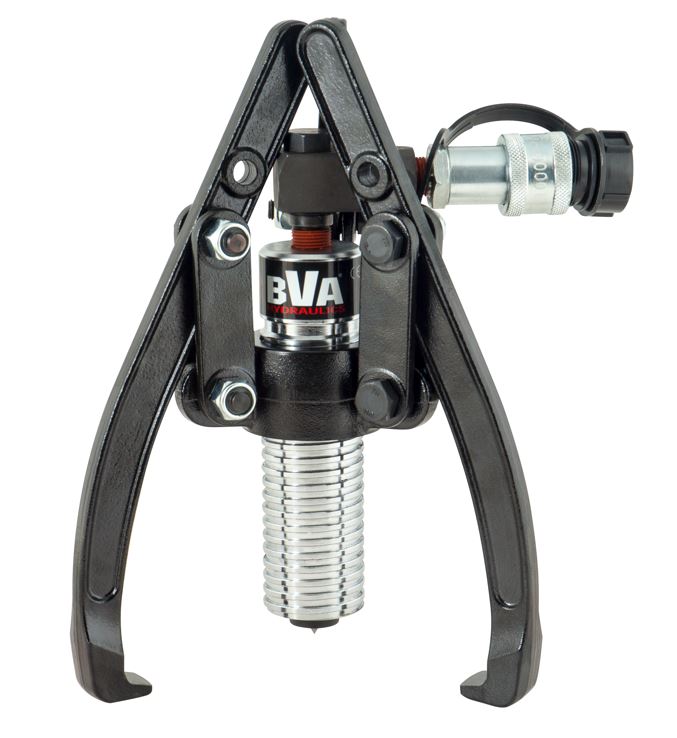
A hydraulic puller trades the sweat and cheater bar of a screw-type puller for a hydraulic cylinder, so a job that used to mean two people on a breaker bar becomes a steady pump of a hand or air pump. This collection is the BVA Hydraulics HGPT gear puller line, a self-contained set offered in 6, 12, 20, 30, and 50 ton capacities, running from a roughly $900 unit to a 50 ton set near $7,750. Each set carries a 10,000 psi single-acting cylinder, reversible jaws that convert between two-jaw and three-jaw, and a protective net over the work. The power unit is sold separately, so match a pump before you order. The guide below sizes the puller to the bearing, gear, or coupling you need to break loose.
Hydraulic Pullers Buying Guide
Size the tonnage to the fit, not the part. The rating on a puller is the force it applies, and the force you need is set by how tight the part sits on the shaft, not by how big the part looks. A lightly seated pulley comes off with a few tons; a bearing that has fretted or rusted onto a shaft, or an interference-fit gear, can need most of a puller's rating to move the first fraction of an inch. Buy up, not to the edge. CCOHS guidance is to use a puller of the required size or larger, and the practical version is to pick the next capacity above your worst-case estimate. The 12 and 20 ton HGPT sets cover most motor, pump, and gearbox work; the 30 and 50 ton sets are for large couplings and heavy industrial fits where a smaller puller would stall or spring its arms.
Reach and spread decide whether it fits at all. Tonnage gets the part moving; geometry decides whether the jaws even reach it. Reach is how far the jaws extend past the cylinder nose to hook behind the part, and spread is how wide they open to clear its diameter. Both scale with capacity here: the 6 ton set reaches about 9.65 inches and opens to 12.99 inches, and the 50 ton set reaches 25 inches and opens to 39.37 inches, with the 12, 20, and 30 ton sets between. Measure the part before you size the puller. A fit you can grip but not reach behind, or a hub wider than the jaws open, sends you up a capacity on geometry alone, regardless of how little force the pull needs.
Two jaws or three, and why three usually wins. Each HGPT set ships with reversible jaws that convert between a two-jaw and a three-jaw pull. Two jaws suit flanged parts, spoked wheels, and anywhere a third arm has nothing to grab. Three jaws are the default for round work: they self-center on the part and share the load across three points, which resists the cocking and slipping that pops a two-jaw setup off under pressure. CCOHS and most tool makers say to use a three-jaw puller when the shape allows, and the reversible design means you are not buying two tools to keep that option.
It needs a pump: budget for the power unit. These are cylinder-and-frame sets, and the power unit is sold separately, so a puller alone will not pull anything. Each set runs a 10,000 psi (700 bar) cylinder through a 3/8 inch NPTF port, which means it pairs with any 10,000 psi pump: a hand pump for occasional shop use, or an air or electric hydraulic power unit where the work is steady. You also need a rated line between them, so add a 10,000 psi hydraulic hose if you do not already run one. Price the pump and hose up front; the sticker on the puller is not the cost of a working setup.
The net is there because parts come off hard. The wire net over each set is not packaging. A gear or bearing under tens of thousands of pounds of pull can let go all at once, and the net keeps a failed jaw, a shattered part, or the shaft end from becoming a projectile. Wear safety glasses or a face shield regardless, keep your body out of the line of the shaft, and back the pressure off if a part refuses to move rather than climbing past the puller's rating. Penetrating oil and controlled heat on the hub free a truly seized fit with less force than muscle alone, and without loading the arms to their limit.
Frequently Asked Questions
Size to the tightness of the fit, not the size of the part. A loose pulley needs a few tons; a rusted or interference-fit bearing can take most of a puller's rating to break the first fraction of an inch. The 12 and 20 ton sets handle most motor, pump, and gearbox work, with the 30 and 50 ton sets for large couplings and heavy industrial fits. Pick the next capacity above your worst case rather than the exact number.
No. The power unit is sold separately. Each set is a 10,000 psi single-acting cylinder with a 3/8 inch NPTF port, so it works with any 10,000 psi hand, air, or electric pump plus a rated hose. Confirm you have or are ordering a pump and line before you buy, because the puller will not build pressure on its own.
The jaws are reversible, so one set does both. Use two jaws on flanged, spoked, or flat-sided parts where a third arm has nothing to grab. Use three jaws on round parts: they self-center and spread the load over three points, which keeps the puller from cocking and slipping off under load. Three jaws are the safer default whenever the shape allows.
Reach and spread scale with capacity. The 6 ton set reaches about 9.65 inches and opens to 12.99 inches; the 50 ton set reaches 25 inches and opens to 39.37 inches, with the 12, 20, and 30 ton sets between. Measure the part before ordering, since a fit you cannot reach behind or a diameter wider than the jaws open forces you up a capacity on geometry alone.
It is, with the right habits. Each set has a protective net because a part under heavy pull can release suddenly. Wear safety glasses or a face shield, keep out of the line of the shaft, use a three-jaw grip when the shape allows, and back off rather than exceeding the rating on a seized fit. Penetrating oil and controlled heat free a stuck part with less force than muscle alone.