Hydraulic Power Units
A hydraulic power unit is the pump, motor, reservoir, and valve that feeds a ram the oil it needs to make its force, and picking the right one comes down to where you work and what you drive with it. This collection is the BVA Hydraulics pump line built to the 10,000 psi high-pressure standard, so any unit here speaks the same language as the cylinders, hoses, and manifolds around it. The range covers three power sources: foot-operated pneumatic treadle pumps that run on shop air and start around $700, electric power units in the four figures for repeatable bench and production cycles, and gasoline power packs past $7,000 for field work with no outlet in reach. A high-output rotary air pump sits in the mix for shops that have compressed air but want faster flow than a treadle gives. Match the source to your site first, then the valve to your cylinder, then the reservoir and flow to your cycle, and the guide below walks that order.
Compare Hydraulic Power Units
| Model | Price | Usable Oil Capacity | Oil Output Flow Rate | Valve Function | Sound Level | |
|---|---|---|---|---|---|---|
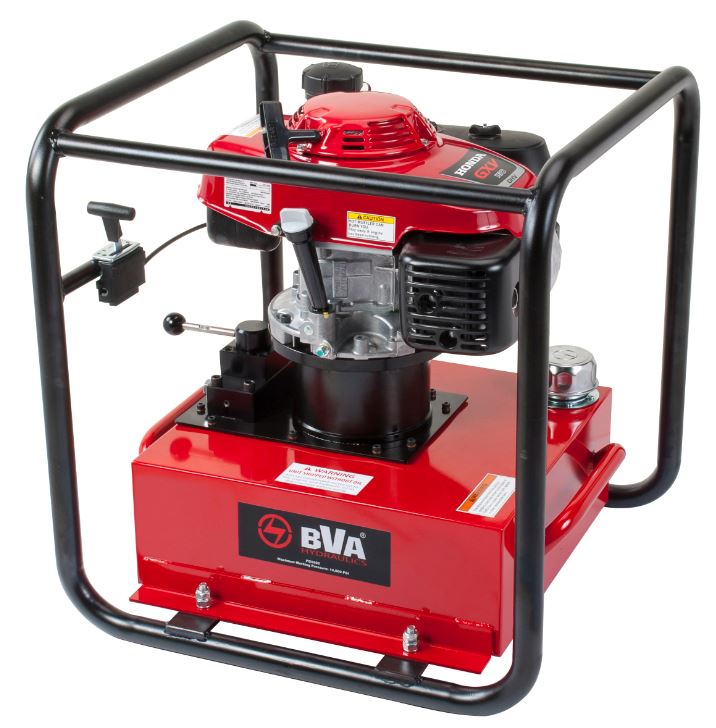
| BVA Hydraulics Gasoline Hydraulic Power Units | $7,209 | 5 gal | 427 in3/min 1st stage / 100 in3/min 2nd stage | Advance/Hold/Return | 93 dBA | View → |
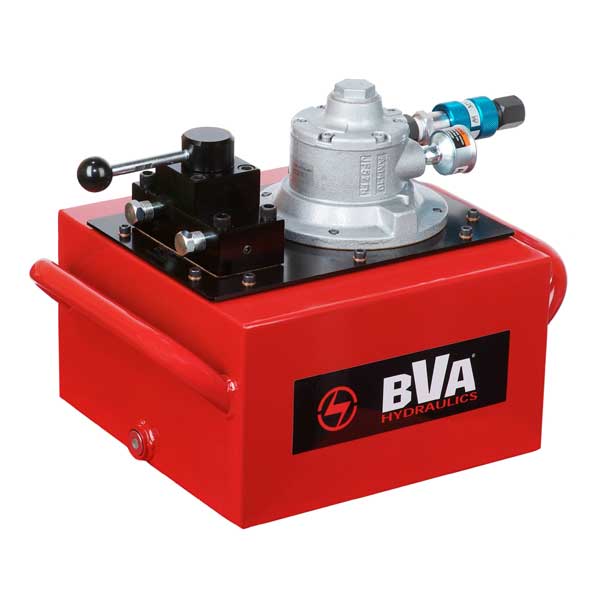
| BVA Hydraulics Rotary Air Pump 4HP 3-Gallon 4W/3P Manual Valve 10,000 PSI | $6,511 | 3 gal | 512 in3/min 1st stage / 70 in3/min 2nd stage | Advance/Hold/Return | 100 dBA | View → |
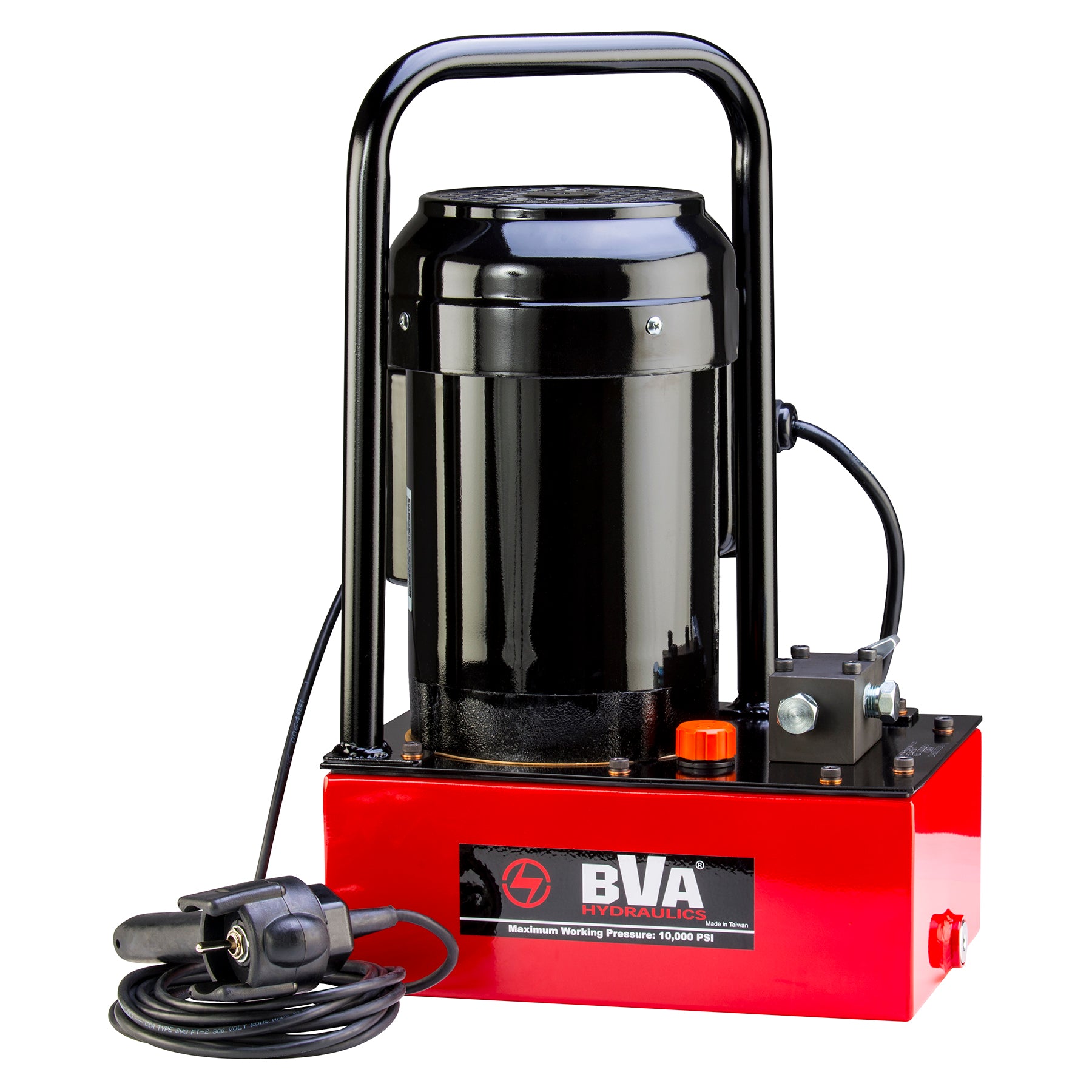
| BVA Hydraulics Electric Hydraulic Power Units | $3,929 | — | — | — | — | View → |
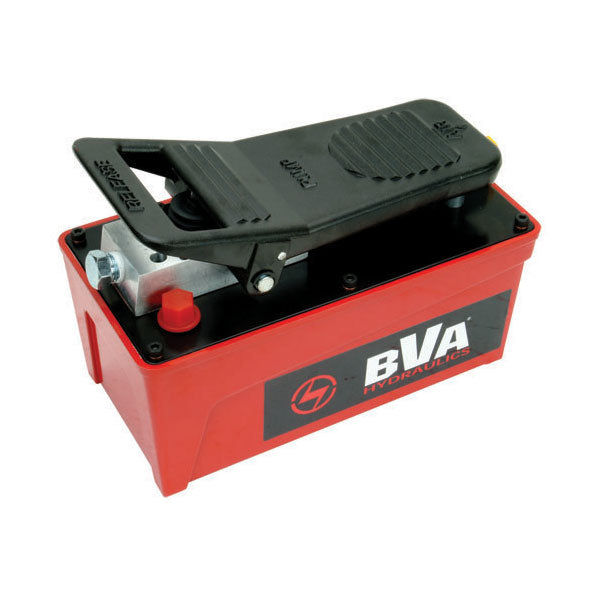
| BVA Hydraulics Pneumatic Treadle Air Pump 10,000 PSI | $727 | — | — | — | — | View → |
 In Stock
 In Stock
 In Stock
 In Stock
Hydraulic Power Units Buying Guide
Match the power source to the site, not the tool. The first decision is where the pump gets its energy, because that is set by your site, not by the ram. Air is the answer where a compressor is already plumbed in and an electrical outlet is not: a pneumatic pump needs only shop air, keeps the operator's hands free, and puts no spark near the work. Electric is the choice for repeatable indoor cycles at a bench or on a line, where a wall outlet is a given and you want the same stroke every time without minding a compressor. Gasoline covers the field, the yard, and the road, where there is no outlet and no air line for miles. Settle that first, then match the pump to the cylinder it has to feed and the hoses that carry the oil between them. When one pump has to drive several rams at once, a manifold splits the flow so the job stays balanced across the lift points.
Air pumps: treadle for the odd job, rotary for volume. Two air pumps sit in this line and they answer very different jobs. The pneumatic treadle pump is the light-duty option, foot-operated with its reservoir sized in cubic inches rather than gallons, from a compact 36.6 cubic inch head up to 460.6 cubic inches for longer strokes. It starts around $700, runs on ordinary shop air in the 60 to 150 psi range, and is the sensible buy for the occasional press or ram job where the operator wants both hands on the work and a foot on the pedal. The rotary air pump is the other end of the same idea: a 4 horsepower air motor turning a 3 gallon reservoir, priced past $6,000, built for shops that have compressed air and want the flow to cycle a cylinder quickly rather than nudge it along. Both need a compressor that can hold pressure and volume under a sustained pull, so confirm your air supply before you count on either.
Electric power units: the shop workhorse. The electric power units are the workhorse of the group, and they scale from a 1/2 horsepower, 1 gallon unit through 1 and 1.5 horsepower models on 2 and 3 gallon reservoirs, with 2.5 gallon builds in the mix. All run on 120V through a standard NEMA 5-15P plug, so any shop outlet powers them, and most are offered with an optional 10 foot pendant that moves the start-stop and valve control to your hand at the work instead of back at the pump. Prices run from about $3,700 up toward $8,900 as horsepower, reservoir size, and the valve package climb. Electric motors carry a duty-cycle rating, so for steady production cycling lean toward the larger horsepower units built to run rather than a small pump asked to work past its rest intervals. This is the source to default to whenever a wall outlet is within reach and the pump lives indoors.
Gasoline power packs: force where there is no power. When the job is in the field with no outlet and no air, the gasoline power pack is the answer. This line runs a 5.5 horsepower engine on a 5 gallon reservoir, offered with either a 3-way/3-position or a 4-way/3-position valve, and it lands past $7,000 because you are buying the engine, the tank, and the freedom to work anywhere. Treat it like any small engine: it needs fuel, ventilation, and the same do-not-run-it-indoors discipline as a generator, since the exhaust is the hazard a corded pump never has. The 5 gallon reservoir also means it carries enough oil to feed a large ram through a full stroke without running dry. If the work is genuinely portable, this is the only source on the page that goes where there is nothing to plug into.
The valve decides which cylinder the pump can run. The valve on the pump decides which cylinder it can run, so read it before you buy. A 3-way, 3-position valve feeds a single-acting cylinder: oil pushes the plunger out, and a spring or the load's own weight pushes it back. A 4-way, 3-position valve feeds a double-acting cylinder, powering the plunger both out and back for a controlled return or a pull. The 2-way/2-position dump valve on the smallest electric unit is the simplest single-acting control, pressure then dump. If you already own the ram, match the valve to it; if you are buying both, the cylinder and pump sets pair a matched ram and pump so the valve, flow, and fittings are settled out of the box. Solenoid and manual locking-valve options hold pressure for work that has to stay put under load rather than drift back.
Size the reservoir to the cylinder, the flow to the cycle. Two numbers finish the spec: usable oil and flow. The reservoir has to hold enough oil to fill the cylinder through its full stroke with reserve left in the tank, so the rule of thumb is a reservoir carrying the cylinder's swept volume plus roughly 20 percent, which is why a long-stroke or large-bore ram pushes you from a 1 gallon pump up to 3 or 5 gallons. Flow, measured in cubic inches per minute, sets how fast the plunger moves: a big cylinder on a small pump extends slowly, which is fine for a one-off press and frustrating for a job you repeat all day. Total the oil your ram needs, pick the reservoir above it, then choose the horsepower or air motor that delivers the flow your cycle time can live with. Buying the pump before the cylinder is settled is how a shop ends up with a ram it cannot feed fast enough.
Frequently Asked Questions
Match the source to your site. Choose air where a compressor is plumbed in and there is no outlet, since a pneumatic pump needs only shop air and keeps your hands free. Choose electric for repeatable indoor cycles at a bench or line off a standard 120V outlet. Choose gasoline for the field or yard where there is no power at all. The ram does not care which source feeds it, so let the location decide.
It depends on your cylinder. A 3-way, 3-position valve runs a single-acting cylinder, powering the plunger out while a spring or the load returns it. A 4-way, 3-position valve runs a double-acting cylinder, powering it in both directions for a controlled return or a pull. Read your ram's spec first, or buy a matched cylinder and pump set so the valve is already correct for the cylinder it ships with.
The reservoir must hold enough oil to fill your cylinder through its full stroke with reserve to spare, roughly the cylinder's swept volume plus about 20 percent. A short-stroke 2 or 5 ton ram is happy on a 1 gallon unit, while a long-stroke or large-bore cylinder pushes you to 3 or 5 gallons. Total the oil the ram actually needs before you pick the pump, because a reservoir that runs low mid-stroke starves the pump.
Compressed air, nothing else. The treadle pump runs on ordinary shop air in the 60 to 150 psi range and is foot-operated, so both your hands stay on the work. The one thing to confirm is that your compressor can hold pressure and volume through a sustained pull, since a pump starved of air will stall partway up a heavy stroke.
Yes, with a manifold that splits the pump's flow to several rams. That is how a level multi-point lift keeps every corner moving together instead of racking the frame. Size the pump's reservoir and flow to feed all the cylinders it has to drive at once, since dividing the oil among them also divides the speed each one moves at.