Why angle matters so much
Sling angle is one of the most misunderstood, and most dangerous, aspects of rigging. When slings pull straight down (vertical), each leg carries its share of the load and nothing more. But the moment the legs angle outward to reach spread-apart lift points, the tension in each leg climbs, because the sling is now fighting both the downward weight and the horizontal pull. The wider the angle from vertical, the higher the tension, until a modest-looking lift secretly overloads the slings. Understanding this is the difference between a safe lift and a sling failure that looks fine on paper.
The load-angle factor
The relationship is captured by the load-angle factor, the sine of the angle measured from horizontal. At 90 degrees (vertical), the factor is 1.000, the sling carries its full rated capacity. At 60 degrees it drops to 0.866, at 45 degrees to 0.707, and at 30 degrees to 0.500, meaning the sling's usable capacity is cut in half. You multiply the sling's rated capacity by this factor to get its actual capacity at that angle. The flatter the sling, the smaller the factor, and the less it can safely lift. Always measure the real angle and apply the factor.
What the numbers mean in practice
Consider a 10,000-lb load lifted with two sling legs. If the legs are vertical, each carries 5,000 lb, simple. But angle those legs to 30 degrees from horizontal, and each leg's tension jumps to roughly 10,000 lb, the same as the entire load, on each leg. That's a 100 percent overload compared to the naive expectation, and it's exactly how riggers get caught out. The load didn't change; the geometry did. This example is why you never eyeball a multi-leg lift, you calculate the leg tension using the angle.
The 30-degree hard limit
There's a firm rule: sling angles below 30 degrees from horizontal must never be used. As the angle drops below 30 degrees, the tension in each leg rises so steeply that it quickly exceeds safe limits, and small errors in angle produce large errors in load. Thirty degrees is the practical floor for safe rigging, and even there, capacity is halved. Whenever a lift would require flatter slings than that, you change the rigging, use longer slings, a spreader bar, or different lift points, rather than accepting a dangerous angle. Treat 30 degrees as a line you don't cross.
How to avoid dangerous angles
The fix for a bad angle is almost always the rigging setup, not accepting the risk. Longer slings raise the hook and steepen the leg angle toward vertical, reducing tension. A spreader bar holds the lift points apart so the slings stay vertical regardless of load width, which is exactly what spreader bars are for. Choosing lift points closer together also steepens the angle. Plan the geometry before the lift: aim to keep sling legs as close to vertical as practical, and reach for a spreader bar when a load is wide enough to force a flat angle.
Hitch type matters too
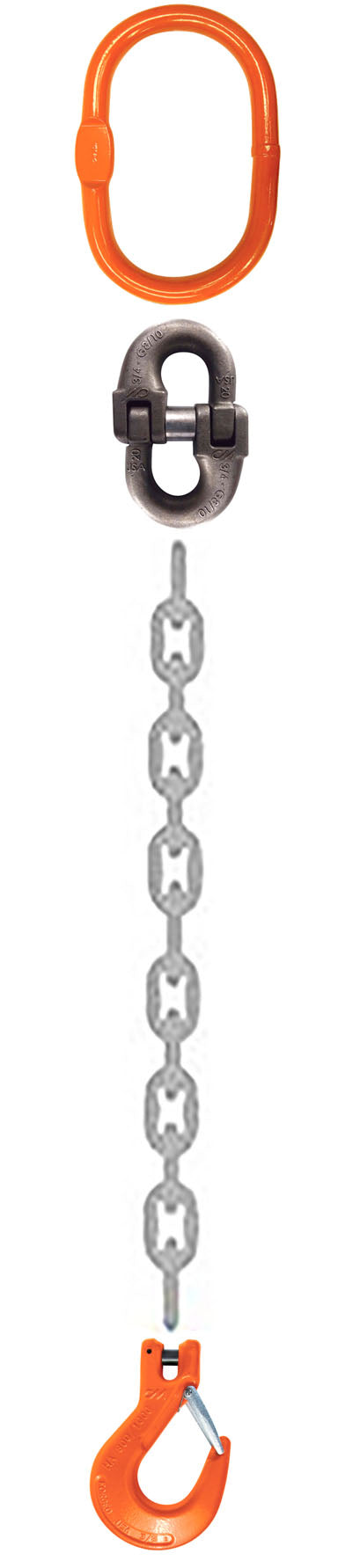
Beyond leg angle, the way a sling is hitched changes its effective capacity. A vertical hitch gives full rated capacity. A choker hitch, where the sling wraps and cinches the load, reduces capacity (commonly to around 75 to 80 percent) because of the bend and squeeze at the choke point. A basket hitch can increase capacity when rigged correctly, but the basket's angle then follows the same load-angle rules above. So the real capacity of a sling in a given lift depends on both the hitch and the angle, both of which you account for using the manufacturer's chart. Choose slings, like a chain sling, rated for the combined effect.
Always use the load chart
The safe practice is never to rely on memory or estimation for a real lift: use the sling manufacturer's load chart, which lists rated capacities at standard angles and hitches. Measure or accurately estimate the actual sling angle, find the corresponding factor or charted capacity, and confirm it exceeds the leg tension your load produces. The chart takes the guesswork out and reflects the specific sling's construction. Combined with knowing the load-angle factors, the chart is how riggers turn the physics into a safe, confirmed lift rather than a hopeful one.
The bottom line
Sling angle dramatically affects capacity: as legs move from vertical toward horizontal, tension rises and usable capacity falls, by the load-angle factor of 1.0 at 90°, 0.866 at 60°, 0.707 at 45°, and 0.5 at 30°, with angles below 30° from horizontal forbidden. Calculate leg tension using the angle, never just divide the weight, keep slings as vertical as practical, use a spreader bar for wide loads, and always confirm against the manufacturer's load chart. See our full lifting slings guide for the bigger picture.
Measuring the angle correctly
To apply the load-angle factor, you need the actual angle, and it's measured from the horizontal to the sling leg, not from vertical. A common mistake is measuring from the wrong reference and getting the factor backwards, which is dangerous because it overstates capacity. In the field, riggers estimate the angle from the geometry (the height of the hook above the load versus the horizontal spread of the lift points) or use an angle indicator. When unsure, rig steeper, closer to vertical, which is always the safer error. Getting the angle right is the whole basis for a correct capacity calculation.
Why wide loads force the issue
Sling angle becomes a problem mainly with wide loads, because reaching lift points that are far apart forces the slings flat. A narrow load lets the slings hang nearly vertical from a single hook; a wide load pulls them out toward horizontal, driving up leg tension. This is precisely why spreader bars exist: the bar holds the lift points apart so the slings drop vertically to the load regardless of its width. If you find a load is wide enough to flatten your slings past a safe angle, that's the signal to add a spreader bar rather than accept the reduced capacity.