The three crane types
These are the three most common industrial crane types, and they cover progressively larger areas. A jib crane has a boom that rotates around a fixed pivot, covering a circular or fan-shaped area at one or two workstations. A gantry crane is a horizontal bridge carried on two legs that roll on floor tracks or casters, so the whole crane moves. A bridge or overhead crane runs on elevated runway rails permanently supported by the building, covering an entire rectangular bay. Each suits a different scale of coverage and load.
The jib crane: localized workstation lifting
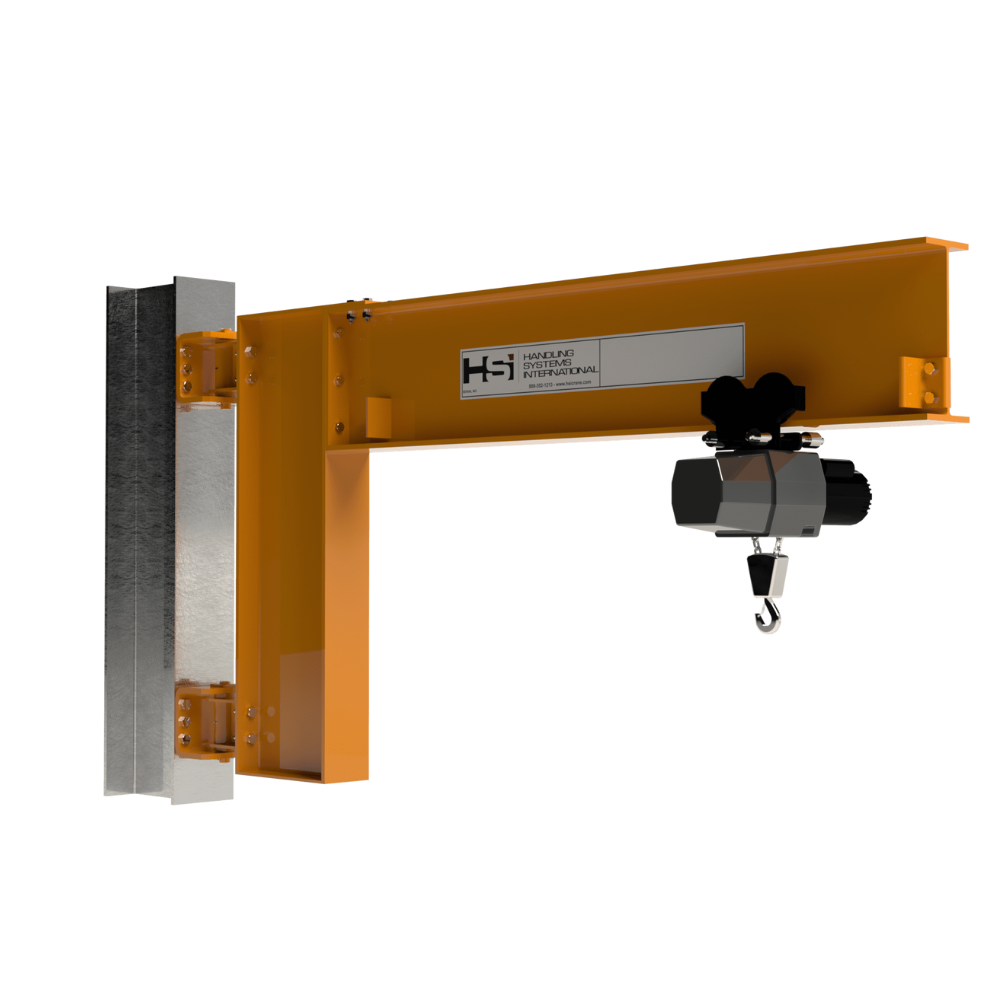
A jib crane is the smallest-coverage option, and it's about repetition at a point. Its rotating boom sweeps a load through an arc, so it excels at repeated lifts at a single workstation, a machine, an assembly bay, a loading spot, usually with lighter loads (commonly a few tons or less). It's the most economical way to add lifting where the work is concentrated in one place, and it needs only a foundation or wall mount, not a building-spanning structure. Choose a jib when your lifting happens over and over in one localized area.
The gantry crane: mobile, no building support
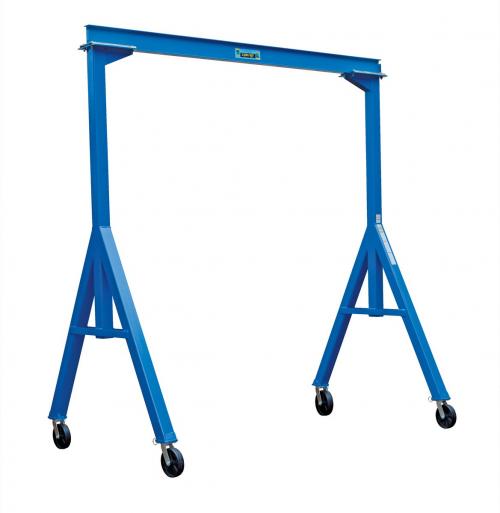
A gantry crane trades fixed coverage for mobility. Because its bridge rides on two wheeled legs rolling on the floor (on tracks or casters), the whole crane can be positioned where it's needed, and it provides heavy-duty capacity without any building support steel, which also makes it generally cheaper than a bridge crane. Gantries suit shops that lift heavy loads at changing locations, outdoor yards, and facilities that can't or don't want to build permanent runway structure. Choose a gantry when you need real capacity and the flexibility to move the crane, without investing in fixed overhead structure.
The bridge (overhead) crane: whole-bay heavy work
A bridge crane is the largest and most capable. Its bridge rides on elevated runway rails that are permanently supported by the building's columns and structure, so it covers an entire bay, the full rectangle under the rails, and handles the heaviest loads and highest throughput. The permanent mounting allows the strongest bracing and the biggest capacities, but the crane isn't portable and requires significant structural investment. Choose a bridge crane when you need to lift heavy loads anywhere across a whole bay, continuously, and you can build the runway structure to support it. It's the backbone of heavy manufacturing.
Coverage: point, mobile, or whole bay
The clearest way to choose is by the area you must cover. Need lifting at one or two fixed spots? A jib crane covers a workstation efficiently. Need to lift heavy loads at various places, or move the crane around? A gantry rolls to where the work is. Need to lift anywhere across an entire bay, continuously? A bridge crane covers the whole rectangle. Map where your loads are and where they need to go, and the coverage pattern usually points to the right crane before you even compare capacities and costs.
Capacity and cost
Capacity and cost rise across the three. Jib cranes are the lightest-duty and most economical, ideal up to a few tons. Gantry cranes deliver heavy capacity at a moderate cost, cheaper than a bridge crane because they need no building structure. Bridge cranes handle the heaviest loads and highest duty but cost the most, since they require permanent runway rails and structural support. So budget and capacity often narrow the field alongside coverage: a jib for light localized work, a gantry for heavy mobile lifting on a moderate budget, a bridge for the heaviest whole-bay work when the investment is justified.
Permanent structure or not
A practical deciding factor is whether you can, or want to, build permanent structure. A bridge crane demands it, runway rails supported by columns or the building frame, which is a major commitment suited to a facility built around heavy lifting. A jib crane needs only a foundation or a wall mount. A gantry needs nothing structural at all; it stands on its own legs. So if you can't modify the building, are renting, or want flexibility, a gantry (or a freestanding jib) gets you lifting without permanent construction. If you're equipping a permanent heavy-manufacturing bay, the bridge crane's structure is worth it.
The bottom line
Choose a jib crane for repetitive lifting at one or two workstations with lighter loads; a gantry crane for heavy, mobile lifting without building support, at moderate cost; and a bridge crane for the heaviest, whole-bay, high-throughput work when you can build permanent runway structure. Decide by coverage area first, then capacity, cost, and whether you can install fixed structure. See our what is a jib crane and what is a gantry crane guides, and compare gantries in our best portable gantry cranes guide.
A quick decision summary
To boil it down: pick a jib for repeated lifts at one or two fixed workstations with lighter loads; pick a gantry when you need heavy capacity but the freedom to move the crane and no building structure; and pick a bridge crane when you must cover an entire bay with heavy loads continuously and can build permanent runway rails. Coverage area is the first filter, then capacity, then whether permanent structure is possible. Most operations that aren't equipping a dedicated heavy-manufacturing bay end up with a jib, a gantry, or both, since bridge cranes are a larger, permanent commitment.