The core difference
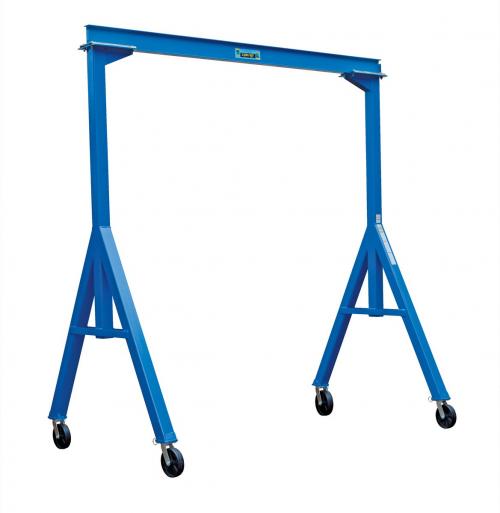
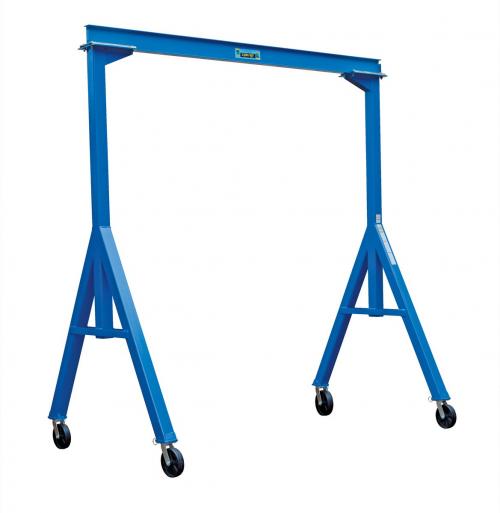
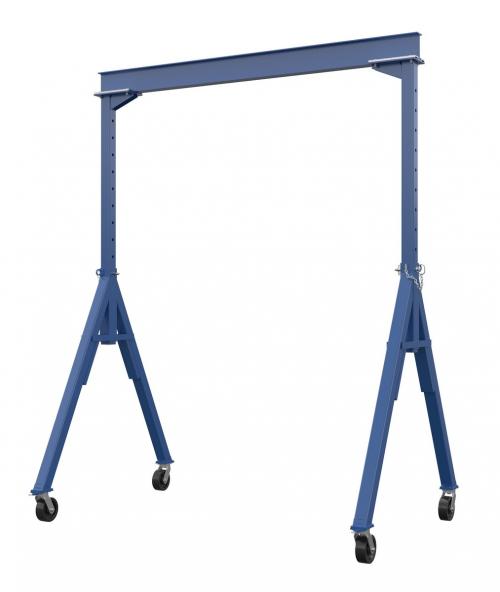
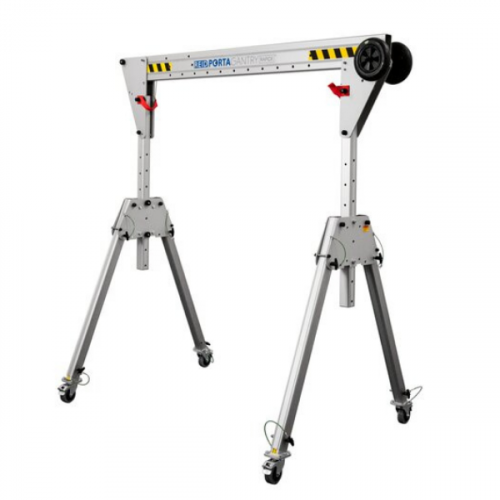
Both are bridge-style cranes with a beam that carries a traveling hoist, but they're supported completely differently. A gantry crane carries its beam on two legs that stand on the floor and roll on wheels, so the crane supports itself and moves. A bridge crane carries its beam on elevated runway rails that are permanently fixed to the building's columns and structure, so the building supports the crane and it covers a set area. That single difference, self-supporting and mobile versus building-supported and fixed, drives the trade-offs in coverage, capacity, cost, and flexibility.
The gantry's advantages
A gantry crane wins on flexibility and cost. It needs no building structure at all, so you can use it anywhere, indoors, outdoors, in a rented space, or where the building can't support an overhead crane, and portable models roll to wherever the work is. It's also considerably cheaper than a bridge crane, since there's no runway rails or structural reinforcement to install. For shops, yards, maintenance, and any operation that values mobility or can't build permanent structure, the gantry delivers heavy lifting without the cost and commitment of a bridge crane.
The bridge crane's advantages
A bridge crane wins on coverage and capacity. Running on permanent runway rails, it covers an entire rectangular bay, the full area under the rails, so it can lift a load anywhere in that bay and move it across the whole space, continuously and at high throughput. The permanent structure allows the strongest bracing and the highest capacities, making bridge cranes the backbone of heavy manufacturing. Nothing a gantry does matches a bridge crane's whole-bay reach and sustained heavy duty. When your operation is built around lifting heavy loads anywhere across a large space all day, the bridge crane is the tool.
Coverage compared
The coverage patterns differ sharply. A gantry covers the area it's positioned in, and a portable one can be moved to cover different spots one at a time, but at any moment it lifts within its own footprint and beam span. A bridge crane covers the entire bay at once, its hoist can reach any point in the rectangle without moving the crane to a new location. So if you need simultaneous coverage of a whole area, the bridge crane is unmatched; if you need to serve different areas at different times, a mobile gantry does it without building-wide structure.
Cost and installation
Cost and installation strongly favor the gantry for most buyers. A gantry stands on its own, so there's essentially no installation beyond assembly, and it's far cheaper than a bridge crane. A bridge crane requires engineered runway rails, structural columns or building reinforcement to support them, and professional installation, a major capital project. So a gantry gets you heavy lifting quickly and affordably, while a bridge crane is a significant, permanent investment justified only when its whole-bay coverage and capacity are genuinely needed. Budget and installation feasibility often decide the choice before capacity does.
Which should you choose?
Choose a gantry crane when you want heavy lifting capacity with mobility and low cost, and you can't or don't want to build permanent overhead structure, which describes most shops, yards, maintenance operations, and rented or temporary spaces. Choose a bridge crane when you need to lift heavy loads anywhere across an entire bay continuously, and you're equipping a permanent facility where the structural investment is justified. For the majority of operations that aren't dedicated heavy-manufacturing bays, a gantry (or a jib) delivers what they need without the bridge crane's cost and commitment.
The bottom line
A gantry crane is a self-supporting, mobile bridge on wheeled legs, heavy capacity, no building structure, lower cost, ideal for shops, yards, and changing locations. A bridge crane runs on permanent runway rails to cover an entire bay with the heaviest loads at high throughput, for facilities built around heavy lifting. Choose the gantry for mobility, flexibility, and value; the bridge crane for maximum whole-bay coverage when you can build the structure. See our what is a gantry crane and jib vs gantry vs bridge guides, and browse our gantry cranes.
Duty and throughput
Consider how hard and how continuously you'll lift. A bridge crane is built for sustained, high-throughput operation, lifting all day across a bay, with a duty rating to match, which is why it anchors heavy manufacturing. A gantry, especially a portable one, suits intermittent and moderate-frequency lifting, moving loads as needed rather than in a constant production flow. If your lifting is near-continuous and central to output, the bridge crane's duty capability matters; if it's periodic, a gantry is more than enough and far cheaper. Match the crane's duty to your real workload, not just its capacity.
Can you use both?
Some facilities run both types for different areas. A bridge crane covers the main heavy-manufacturing bay, while gantries handle lifting in shops, outdoor yards, or areas the bridge crane doesn't reach, or serve as flexible, movable capacity where installing more permanent structure isn't worth it. Rather than treating it as strictly either-or, a large operation may use a bridge crane where whole-bay coverage is essential and gantries for everything else. Match each crane to the area and duty it serves, and the combination can be more cost-effective than forcing one type to cover every need.