Wire Rope Pulleys
A wire rope pulley on a winch line does one specific job: it changes the direction the rope pulls so the winch itself can sit somewhere convenient. This collection centers on the Thern Vertical Lead Block, a 7,000 lb sheave block sized by rope diameter from 1/4 inch through 1/2 inch and priced from about $550 to $825 as the groove gets wider. It is the piece you add when the winch cannot point straight at the load, when the line has to turn a corner, clear a beam, or drop down a shaft. Matching the sheave to your rope and setting it at the right angle to the drum is what keeps the rope from wearing out early, and the guide below covers both.
Wire Rope Pulleys Buying Guide
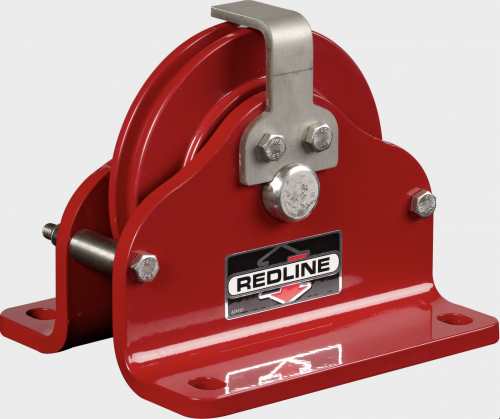
What a lead block actually does. A lead block, sometimes called a lead sheave or fairlead block, is a fixed pulley that redirects a running wire rope. It does not multiply pulling force the way a reeved block system does; a single sheave with the rope end anchored to the load still pulls at 1:1. What it buys you is placement. Mount the winch where there is room and power, then use the block to steer the line to the load around whatever is in the way. Thern builds the Vertical Lead Block for exactly the awkward install: the winch tucked against a wall, the line that has to feed over an obstruction, the pull that starts horizontal and finishes vertical. The rope that runs through it lives in winch ropes, and the two should be sized together.
Match the sheave to your rope. The block is sold by groove size because the sheave has to fit the rope. The Vertical Lead Block covers 1/4, 5/16, 3/8, 7/16, and 1/2 inch cable across five product codes, VLB-G25 through VLB-G50, all rated at 7,000 lb. A groove cut for the wrong diameter pinches a thin rope or crushes a thick one, and either way the rope fails early. The wider the sheave relative to the rope, the gentler the bend and the longer the rope lasts, which is why Thern builds these with large D-to-d ratios. Under ASME B30.26, every block carries markings for the manufacturer, rated load, and acceptable rope sizes; read them and keep them legible, because they are how the next person confirms the block belongs on the line.
Fleet angle: placement drives rope life. Where you set the block relative to the drum decides how evenly the rope spools. The fleet angle is the angle between the rope at the lead sheave and a line square to the drum, and it grows as the block sits closer to the drum or farther off center. Thern's guidance is a maximum of 1-1/2 degrees for a smooth drum and 2 degrees for a grooved drum. Stay inside that and the rope winds in tidy layers; exceed it and the rope piles up on one side, scrubs the flange, and wears. Set the block far enough back and lined up with the drum center before you commit the mount. This matters most on the repeat-duty pulls handled by industrial electric winches and the occasional jobs run with hand winches.
Lead block or snatch block. The two get confused. A lead block is a closed sheave you thread once and leave in place to redirect a line. A snatch block opens on one side so you can drop the rope in at the bight without access to an end, and it is the tool when you want to reeve for mechanical advantage or grab a line already under load. If your job is steering a fixed winch line, the lead block is simpler and cheaper. If you need to install mid-rope or double your pull, look at snatch blocks. For straight-line jobs where the rope itself is the thing being moved, the cable pullers and grips clamp the conductor directly and skip the sheave entirely.
Frequently Asked Questions
It redirects the winch rope so the winch can be mounted where it fits best. Instead of aiming the winch straight at the load, you place it against a wall or near power and use the lead block to turn the line around a corner, over a beam, or down into a shaft.
Five, matched to the groove: 1/4, 5/16, 3/8, 7/16, and 1/2 inch cable, sold as codes VLB-G25 through VLB-G50. Pick the size that matches the rope on your winch drum, since a groove cut for the wrong diameter shortens rope life.
All five sizes are rated at 7,000 lb. That figure is the block's rating; the rope and the winch have their own working load limits, and the weakest link in the line governs, so confirm all three.
A lead block is a closed sheave you thread once and leave in place to change a line's direction. A snatch block opens on one side to drop the rope in mid-line without a free end, and it can be reeved to multiply pulling force. Use the lead block to steer a fixed line, the snatch block to install mid-rope or gain mechanical advantage.
Far enough back and lined up with the drum center to keep the fleet angle small. Thern advises a maximum of 1-1/2 degrees for a smooth drum and 2 degrees for a grooved drum, which lets the rope spool evenly instead of piling on one flange.
No. A single lead sheave only changes direction; with the rope end anchored to the load it still pulls at 1:1. Multiplying force takes a snatch block reeved into a block-and-tackle arrangement.