Hydraulic Spreader Wedge
A hydraulic spreader wedge starts in a gap too thin for any other tool and forces it open, driving a hardened tapered blade between two faces until they part. This collection is built around a single BVA Hydraulics spreader offered in half-ton and one-ton capacities. The one-ton SR10 slips into a 0.47 inch opening, runs on 10,000 psi through a 3/8 inch NPTF port, and carries positive over-travel stops and a return spring so the blade retracts on its own when pressure drops. It is the tool you reach for when a seized pipe flange, a stuck valve joint, or a pinned machine base will not separate and there is no room to swing a hammer. Prices start around $399.
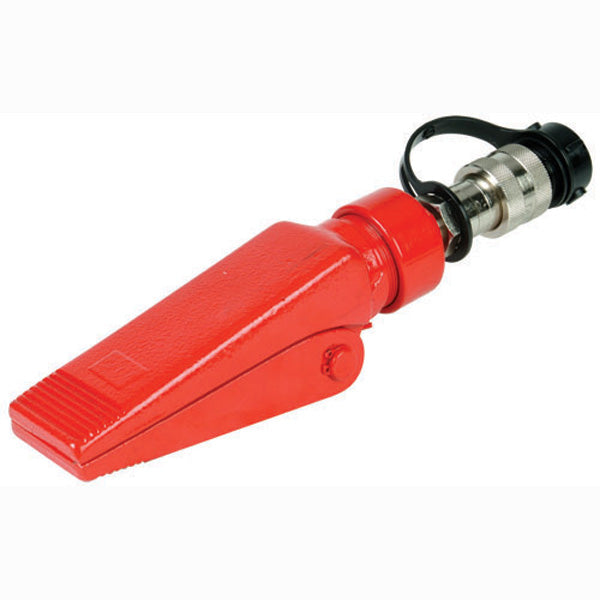
Hydraulic Spreader Wedges Buying Guide
How a spreader wedge actually works. A spreader wedge is a hydraulic ram with a blade instead of a saddle. Pressure from a pump pushes a piston forward, and the piston drives a hardened, tapered wedge into the gap between two faces. The taper is the whole trick: it converts the ram's straight-line push into a much larger force acting sideways, spreading the faces apart. Because the working end is a thin blade rather than a cylinder body, the tool reaches into a joint that has barely opened, where a jack could never sit.
Tip clearance and capacity decide the fit. Two numbers tell you whether a wedge suits the job. The first is tip clearance, the thickness of the blade at its leading edge, because that is the smallest gap it can enter. The BVA one-ton SR10 starts in 0.47 inch, so a flange only has to crack that far before the tool bites. The second is spreading capacity, and this collection covers half-ton and one-ton units. Match the capacity to the joint you expect to break loose, then let the taper multiply the ram force from there. On a stubborn joint, open it in small steps and shim behind the blade with steel blocks so a full load never rests on the wedge alone.
It runs on a separate pump. The wedge is only the business end. It needs a pump to supply the 10,000 psi these tools are built around, connected through the 3/8 inch NPTF port and a high-pressure hose. If you do not already have a 10,000 psi source, price one in from the hydraulic power units alongside the wedge, and route the line so the hose is never kinked or pinched under the load. A hand pump handles occasional flange work; an electric or air unit earns its keep once the wedge sees daily use.
Where the wedge beats a jack. Reach for the wedge when the problem is a thin, stubborn gap in a tight space rather than a clean lift. Seized pipe flanges, stuck valve bonnets, pinned machine bases, and press-fit parts that a hammer only mushrooms are its natural work. The low-profile body slides into recessed and overhead joints where a bottle jack will not fit. When the job is lifting or holding a load instead of parting a joint, a cylinder or jack is the right tool, and the two often travel in the same kit.
Treat it like any 10,000 psi tool. The SR10 carries positive over-travel stops so the piston cannot run out of its bore, and a return spring pulls the blade back when you release pressure, but neither excuses standing in line with the wedge under load. Keep hands and body clear of the blade path, back the spread with blocking, and inspect the tool, hose, and couplers before each use. Replace anything cut, cracked, or leaking with factory parts. A wedge that slips or a hose that bursts at 10,000 psi does not give a second warning.
Frequently Asked Questions
It separates two faces that are stuck or clamped tight, most often pipe flanges, valve joints, and machinery mating surfaces. Hydraulic pressure drives a tapered blade into the gap, and the taper converts that push into a strong sideways spreading force, opening the joint without prying or hammering.
The one-ton SR10 has a 0.47 inch tip clearance, meaning the joint only has to be open that far for the blade to enter. From there the wedge widens the gap step by step. On a joint that is fully seated, you may need to crack it slightly first with a mechanical spreader before the hydraulic wedge can bite.
Yes. The wedge is a ram with no pump of its own. It runs on a 10,000 psi source connected through a 3/8 inch NPTF port and a high-pressure hose. A hand pump works for occasional use, while an electric or air power unit suits frequent work. See the hydraulic power units collection to pair one with the tool.
Both work the same way; the difference is spreading force. The one-ton unit pushes harder on more stubborn or larger joints, while the half-ton suits lighter separation in tight spots. Choose the capacity that matches the joints you break loose most, and remember the taper multiplies the rated force at the blade.
A wedge-type spreader is one kind of flange spreader. It uses a single tapered blade driven by hydraulic pressure to pry faces apart, which is ideal for starting a separation in a very thin gap. Larger flanges are sometimes opened with arm-style spreaders that grip both flange edges, but the wedge is the go-to for tight, low-clearance work.