Synthetic Rope Slings
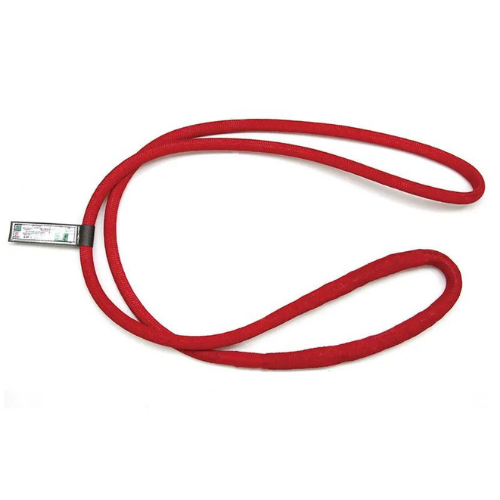
Synthetic rope slings are endless loops of high-strength fiber rope spliced into a continuous ring, and they fill the gap between a webbing sling and a wire rope sling: lighter than either, easy to hand around an awkward load, and gentle enough that they will not mark a finished surface. This shelf carries Holloway Houston Hammerhead endless slings, color-coded by rope diameter from a 3/8 inch purple sling rated 5,700 lb vertical up to a 1-1/4 inch build rated 54,400 lb, in 10, 15, and 20 ft lengths. A synthetic rope sling will not kink, crush, or take a set the way wire rope does, and because the loop is endless you can move the bearing point between lifts to spread the wear. Sizing is the same discipline as any sling: rate off the hitch, not the tag.
Synthetic Rope Slings Buying Guide
Where a rope sling sits in the sling family. The common fiber and metal slings trade off the same way every time. Webbing slings spread the load across a flat face and protect finished surfaces, but that face abrades. Round slings give the cheapest capacity per pound and the softest grip on a load. Wire rope slings and chain slings take the heat and sharp edges that shred any synthetic. A synthetic rope sling lands next to the round sling: a light, flexible fiber sling, but the round cross-section chokes cleanly and handles repeated bending better than a flat web, and it will not crush or kink the way wire rope does. The Lifting Slings hub compares all six types side by side.
Endless construction, and why you rotate it. These are endless slings, sometimes called grommets: one length of rope spliced into a continuous loop with no fitted eyes and no hardware. That shape is the durability trick. Because every part of the loop is identical, you can move the point that bears on the hook or chokes the load from one lift to the next, so wear spreads around the whole sling instead of chewing through one spot. It also means the same sling rigs as a vertical, a choker, or a basket with no adapter.
Color tells you diameter, the tag tells you the rating. Hammerhead uses a color-by-diameter scheme: purple is 3/8 inch at 5,700 lb vertical, green 7/16 inch, yellow 1/2 inch, red 5/8 inch, blue 3/4 inch, and orange covers everything from 7/8 inch up. That means four orange builds rate anywhere from 30,500 to 54,400 lb, so color gets you to the right bin and no further. The sewn tag is the rating. A sling whose tag is missing or unreadable comes out of service, no matter how clean the cover looks. Lengths run 10, 15, and 20 ft.
The hitch and angle still reset the number. The color rating is vertical: one leg, straight pull. Choke the same sling and you get roughly 75 to 80 percent of it, because the choke point pinches the rope. A basket hitch can reach up to double the vertical rating, but only with both legs vertical and a generous contact diameter. And the moment two legs share a hook, leg angle multiplies tension fast, so buy the length that holds your legs at 60 degrees or steeper. Size off the hitch you will actually rig, not the tag number.
Inspect it like any synthetic sling. Synthetic rope slings are built to a 5:1 design factor and fall under OSHA 1910.184 and ASME B30.9, which added a synthetic rope sling chapter in its 2021 edition. Inspect before every shift and retire a sling for cuts, abrasion or fuzzing that exposes the core, chemical or acid attack, and any melting, charring, or glazing from heat and friction. Fiber ropes shrug off water and most chemicals but hate sharp edges, so pad every corner and keep them out of direct sunlight in storage.
Frequently Asked Questions
It is a single length of synthetic fiber rope spliced into a continuous loop with no eyes or hardware. Any part of the loop can bear on the hook or choke the load, and rotating that point between lifts spreads the wear and extends the sling's service life.
Both are soft fiber slings, but a round sling carries its load on a bundle of parallel yarns inside a woven jacket, while a rope sling is spliced from finished rope. The rope shape chokes more cleanly and takes repeated tight bends, while a round sling gives the cheapest capacity per pound and the softest grip.
The Hammerhead line is rated by rope diameter, from 3/8 inch at 5,700 lb vertical up to 1-1/4 inch at 54,400 lb, each offered in 10, 15, and 20 ft lengths. Pricing runs from about $222 to $1,640 depending on diameter and length.
The tag rating is vertical: one leg on a straight pull. A choker hitch drops it to roughly 75 to 80 percent, while a basket hitch can reach up to double the vertical rating when both legs stay vertical over a generous contact diameter. Always size off the hitch you plan to rig.
Immediately, under OSHA 1910.184 and ASME B30.9, for cuts, abrasion or fuzzing that exposes the core, chemical or acid burns, melting, charring or glazing from heat, or a missing or unreadable tag. Inspect before every use and pad any sharp edge.