4 Leg Chain Slings
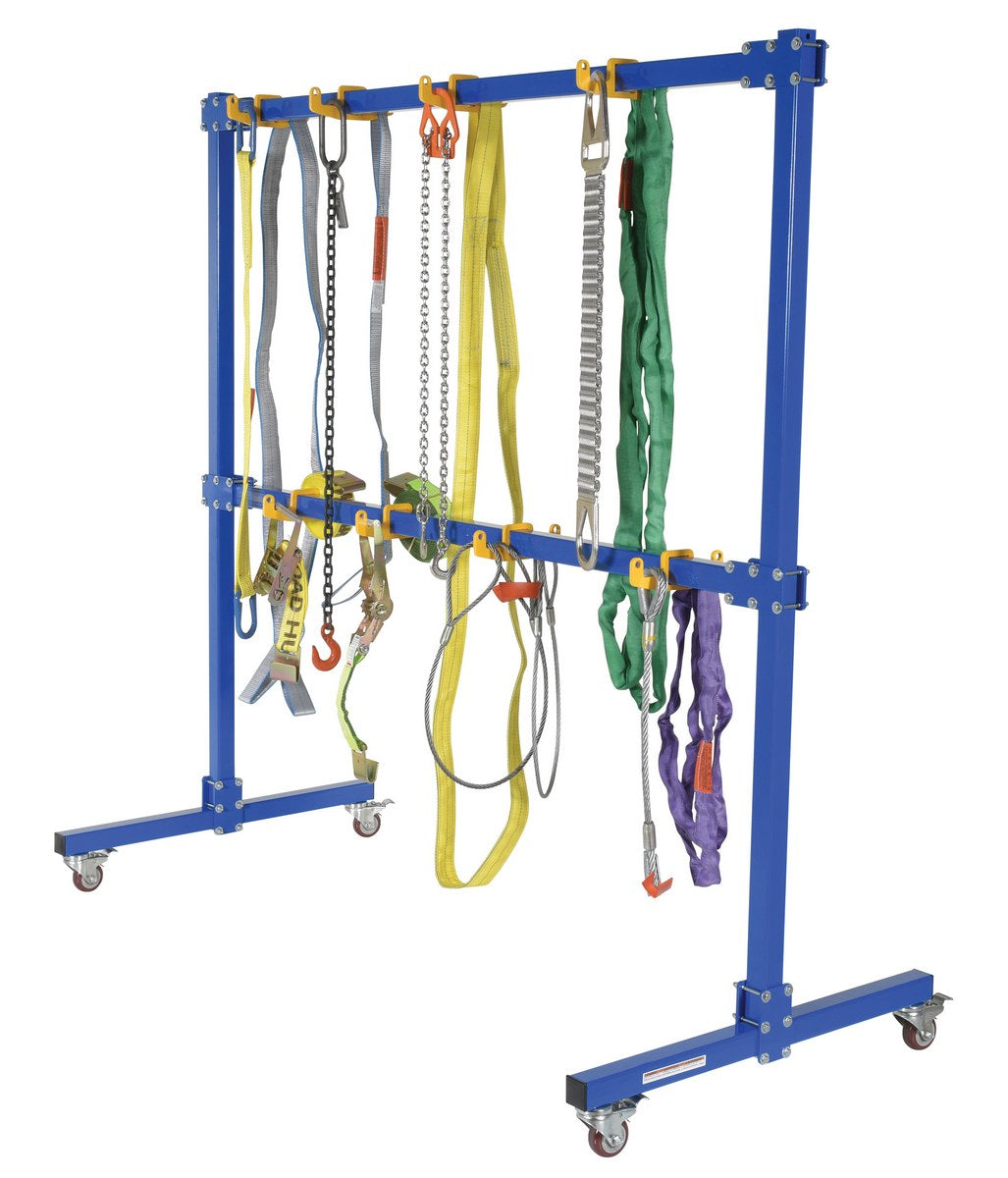
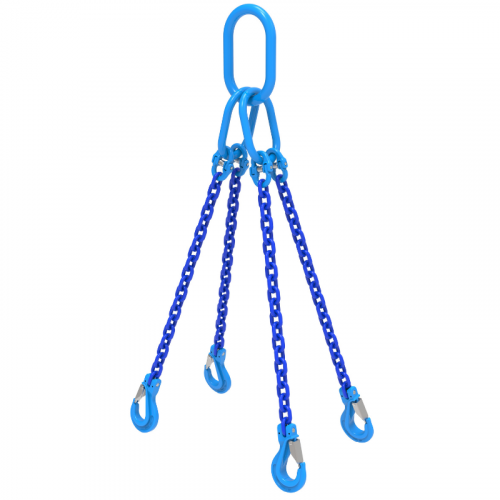
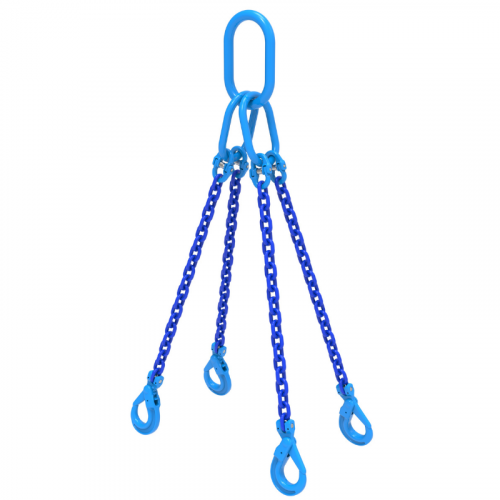
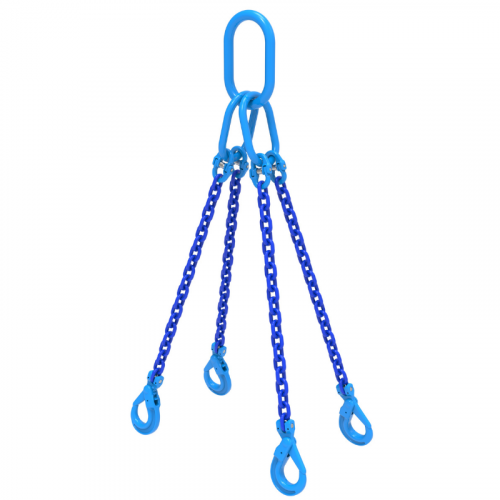
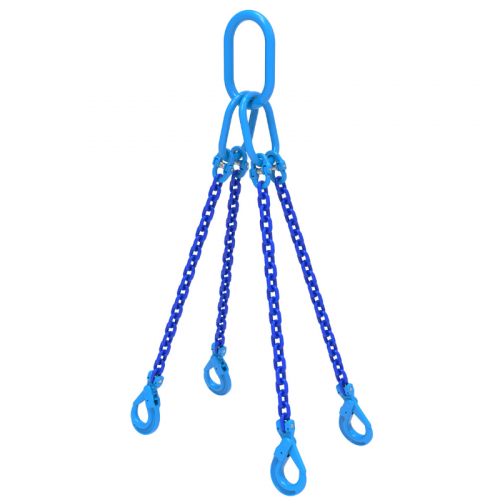
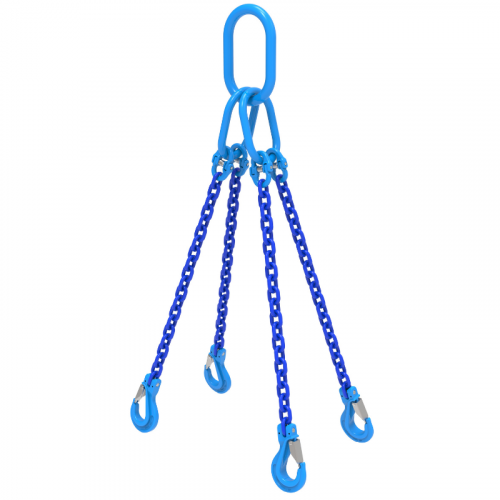
A 4 leg chain sling puts a master link at the crane hook and four rated legs down to the corners of a rigid load, so a machine base, a fabricated frame, or an engine skid rides level instead of tipping on a two-point pick. This collection is built on William Hackett Grade 100 assemblies, from a 1/4 inch build rated 5,700 lb around $388 up to a 1-1/4 inch assembly rated 191,700 lb, each proof tested and tagged as one unit in effective working lengths from 3 to 30 ft. Grade 100 alloy carries roughly 25% more working load than Grade 80 at the same chain diameter, so these slings hit a given rating on lighter, thinner chain, which matters when a rigger is hauling four legs up to a pick. Every assembly configures with standard latch hooks or self-locking hooks and optional chain adjustment grab hooks for leveling off-center loads, and a Vestil sling rack keeps the fleet off the floor between inspections.
Compare 4 Leg Grade 100 Chain Slings
| Model | Price | Overall Length | Capacity | |
|---|---|---|---|---|
| William Hackett 1-1/4 Inch Diameter 191700lbs 4-Leg Chain Sling | $17,893 | 3-30 ft | 191700 lb | View → |
| William Hackett 7/8 Inch Diameter 90600lbs 4-Leg Chain Sling | $2,127 | 3-30 ft | 90600 lb | View → |
| William Hackett 3/4 Inch Diameter 74900lbs 4-Leg Chain Sling | $1,595 | 3-30 ft | 74900 lb | View → |
| WH 5/8 Inch Dia. x WLL 47900lbs 4-Leg Grade 100 Chain Slings | $1,555 | 3-30 ft | 47,900 lb | View → |
| WH 1/2 Inch Dia. x WLL 31800lbs 4-Leg Grade 100 Chain Slings | $901 | 3-30 ft | 31,800 lb | View → |
| WH 3/8 Inch Dia. x WLL 18700lbs 4-Leg Grade 100 Chain Slings | $600 | 3-30 ft | 18,700 lb | View → |
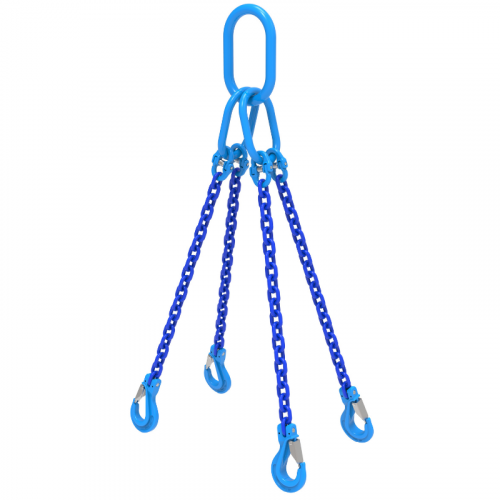 In Stock
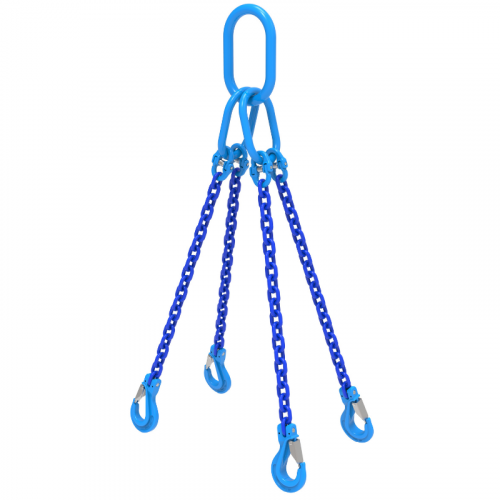 In Stock
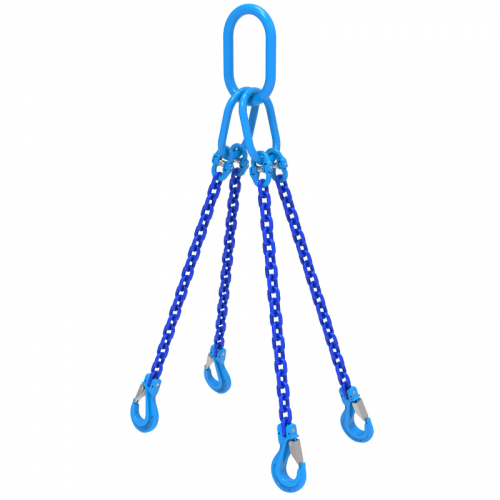 In Stock
 In Stock
 In Stock
 In Stock
 In Stock
 In Stock
 In Stock
4 Leg Grade 100 Chain Slings Buying Guide
Why four legs, and when two will do. Four legs earn their keep on one kind of load: a rigid body with four fixed pick points that has to ride dead level, like a machine base, a fabricated frame, an engine skid, or a transformer with a lug at each corner. Spread the pull across four points and the load stays flat as it leaves the ground. If the load hangs plumb from one point, a single leg sling is simpler and cheaper; if it has two lift points and only needs to stay level along one axis, the 2 leg assemblies do the job with less chain to manage. Reach for four legs when the load genuinely has four hard points, because a fourth leg on a load that does not need it adds weight and a leg that may carry nothing. The broader chain sling hub lays the leg counts and grades side by side if you are still deciding.
The 4-leg rating counts three legs, not four. Here is the number that surprises people: a 4-leg chain sling is not rated at double the 2-leg. On the William Hackett tags the 4-leg rating works out to three legs carrying at 45 degrees from horizontal, not four. The 1/2 inch line makes it plain. The single leg carries 15,000 lb, the double 21,200 lb, and the 4-leg 31,800 lb, which is 1.5 times the double rather than twice it. The reason is geometry you cannot cheat: a rigid load will not share evenly across four legs, because three points define a plane and the fourth leg lands wherever the load and the rigging put it. In practice three legs carry while the fourth balances, so the rating counts three and treats the fourth as insurance against tipping. The 45 degree assumption carries its own warning. Rig steeper than 45 degrees and each leg sees less tension than the tag assumed, margin in your favor. Rig flatter and tension climbs fast, reaching double each leg's share at 30 degrees, where the capacity charts stop. Longer legs stand steeper, so when headroom allows, order the longer working length and the printed rating stays honest.
Size across the line from the tag. The William Hackett 4-leg line climbs by chain diameter, and the tag is the number that governs, not the color or the heft. It starts at 1/4 inch chain rated 5,700 lb from about $388 and steps up through 5/16 inch at 12,100 lb, 3/8 inch at 18,700 lb, 1/2 inch at 31,800 lb, 5/8 inch at 47,900 lb, 3/4 inch at 74,900 lb, and 7/8 inch at 90,600 lb, to a 1-1/4 inch assembly rated 191,700 lb for the heaviest structural picks. Every configuration ships in effective working lengths from 3 to 30 ft, measured master link bearing point to hook bearing point, and length is worth buying: longer legs keep your sling angle steep, which is the cheapest way to protect the rating. Match the tag to the load plus a real margin, remembering the number assumes a rigid four-corner pick at 45 degrees. If your loads vary in size, buying a longer reach and the grab hook option below covers more of them than chasing an exact fit on every job.
Hooks and grab hooks: the options that change the sling. Two build choices do more than the rest. The first is the hook. A standard sling hook with a spring latch is the default and fine for most work, but a self-locking hook positively latches under load and cannot be knocked open by a shifting rig or a snagged tail, which is the safer pick for repetitive or overhead-traffic lifts. The second is the chain adjustment grab hook on each leg. Without it, every leg is fixed at its tagged reach, and an off-center load leaves one leg slack and the pick tilted. Add grab hooks and a rigger shortens a leg in the field by hooking a link farther up, taking up the difference to level the load without ordering a custom sling for every awkward pick. That single option turns one 4-leg assembly into an adjustable bridle that handles a whole shop's worth of uneven loads. For crews that build and repair their own rigs, the Grade 100 chain components shelf carries the master links, coupling links, and hooks to match, assembled and proof tested by a qualified person before the first lift.
Grade, heat, and the ASME B30.9 rules. Chain is the sling you buy for the conditions that end synthetics, and the rules come with the grade. Overhead lifting chain must be alloy steel under OSHA 1910.184 and ASME B30.9, and every assembly here is Grade 100, which carries roughly 25% more working load than Grade 80 at the same diameter and holds its full rating to 400 F, with published reductions above that. That heat tolerance is why loads out of heat treat and off weld tables ride on chain while a round sling or webbing sling would already be out of service. Inspection follows ASME B30.9: a visual check each day the sling is used plus a documented periodic inspection at least every 12 months, tightening to monthly or quarterly in hard service. The periodic look is link by link, and reach is the tell for stretch, so measure bearing point to bearing point against the tagged length. The tag itself is pass-fail: no legible size, grade, reach, and rating, no lift. A $519 Vestil sling rack keeps the fleet hung, sorted, and off the floor between those inspections. To weigh Grade 100 against the rest of the chain sling family or the other sling types, the lifting slings hub lays them side by side.
Frequently Asked Questions
Because a rigid load cannot be trusted to load four legs evenly. Three points define a plane, so three legs carry while the fourth balances, and the William Hackett tags rate the 4-leg as three legs at 45 degrees. On the 1/2 inch line that is 31,800 lb for the 4-leg against 21,200 lb for the double, 1.5 times rather than twice. Rig steeper than 45 degrees to add margin, and flatter than 30 degrees is off the charts.
When the load is rigid and has four fixed pick points that must ride level, such as a machine base, a fabricated frame, or a skid with a lug at each corner. If it hangs plumb from one point use a single leg, and if two points hold it level a double leg is lighter and cheaper. A fourth leg on a load that does not need it adds weight and may carry nothing.
Yes, if you order the chain adjustment grab hook option on the legs. It lets a rigger hook a link farther up to take up a leg in the field, leveling an uneven load without a custom sling. Without grab hooks each leg is fixed at its tagged reach, and an off-center pick leaves one leg slack and the load tilted.
The standard sling hook with a spring latch handles most work. Step up to the self-locking hook when the sling sees repetitive lifts or overhead traffic, because it positively latches under load and will not be knocked open by a shifting rig or a snagged tail. Both options ship matched and proof tested with the assembly.
Full working load limit to 400 F, per OSHA's alloy chain sling guidance, with published reductions above that both during and after exposure. That is why chain handles loads out of heat treat and off weld tables that would pull a polyester sling from service well below 200 F. For the hottest work, follow the manufacturer's derating table.
Under ASME B30.9, a visual check each day it is used and a documented periodic inspection at least every 12 months, more often in severe service. Inspect link by link, measure the reach bearing point to bearing point against the tagged length to catch stretch, and reject bent, gouged, or cracked links and sprung hook throats. If the tag is not legible, the sling comes out of service.